South East of Starveall Farm
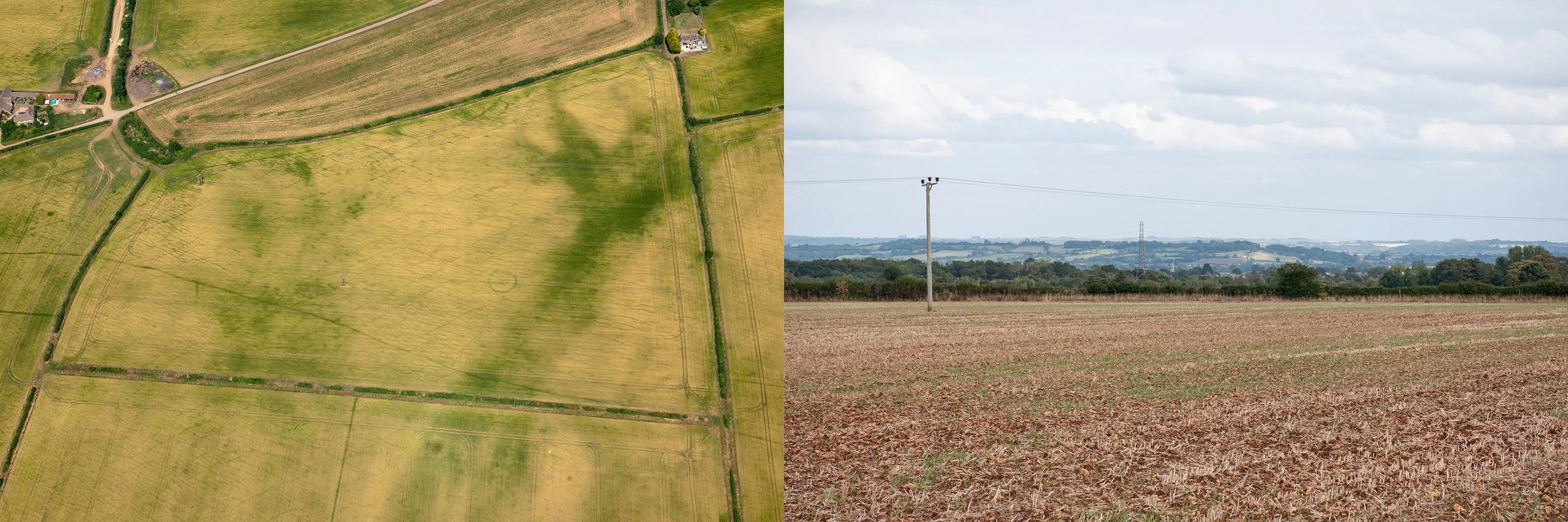
Aerial photograph showing the crop mark of a Bronze Age round barrow, taken 12th July 2013, by Damien Grady, for Historic England. Second photograph, the site of the round barrow, taken 4th September 2024, from the shortest side of the large field
My first visit was a recce. I had been looking at other sites and continued down the lane towards Starveall. To begin with there were hedges, thickened by annual cultivation, on both sides of the lane, but once past the turning for Cherry Patch Cottage, there was just the road, a low bank on both sides, then grassland. It had an unusual open feeling, after the lanes which dipped between the hedgerows, with no view beyond. Harebells grew amongst the grasses on the verge above the bank. I had heard that in the 1960s a dotterel had been seen here, an unusual sight, as it had strayed from its migratory path. I continued along the lane and turned into the field where the Bronze Age round barrow had been situated, somewhere in the far corner on the high, flat piece of land.
I contacted the farmer and gained permission to walk around the edge of the field, taking photographs. The next time I visited the site I had the aerial photograph of the crop mark with me; it showed a ring, dark green, on dry yellowed ground. I started on the top, northern, edge of the field. I had calculated a grid reference, which I checked using my phone; this told me where I needed to stand, in order to have the invisible site framed by my camera, but in reality it was not necessary because I was able to use the positions of telegraph poles, along with the aerial photograph, to locate the site of the ring ditch. The circle would not have been large; it was approximately fifteen metres across and it would be easy to lose its position in the photograph, flattened by perspective, with attention drawn to actual landmarks – a church spire pointing up on the outskirts of Chippenham and nearer, telegraph poles and pylons in the adjacent fields. I positioned myself, took some photographs, then walked along to the eastern edge, stopping to pick up a small black and red stone to add to a collection of stones from the sites. Whatever crop was growing had been cut; the earth was brown, with yellow stubble. A kite drifted above me, its tail fanned out. Far away, near a strip of tall grasses, golden already, hares, large creatures, like small dogs, unaware of my distant presence, went about their business.
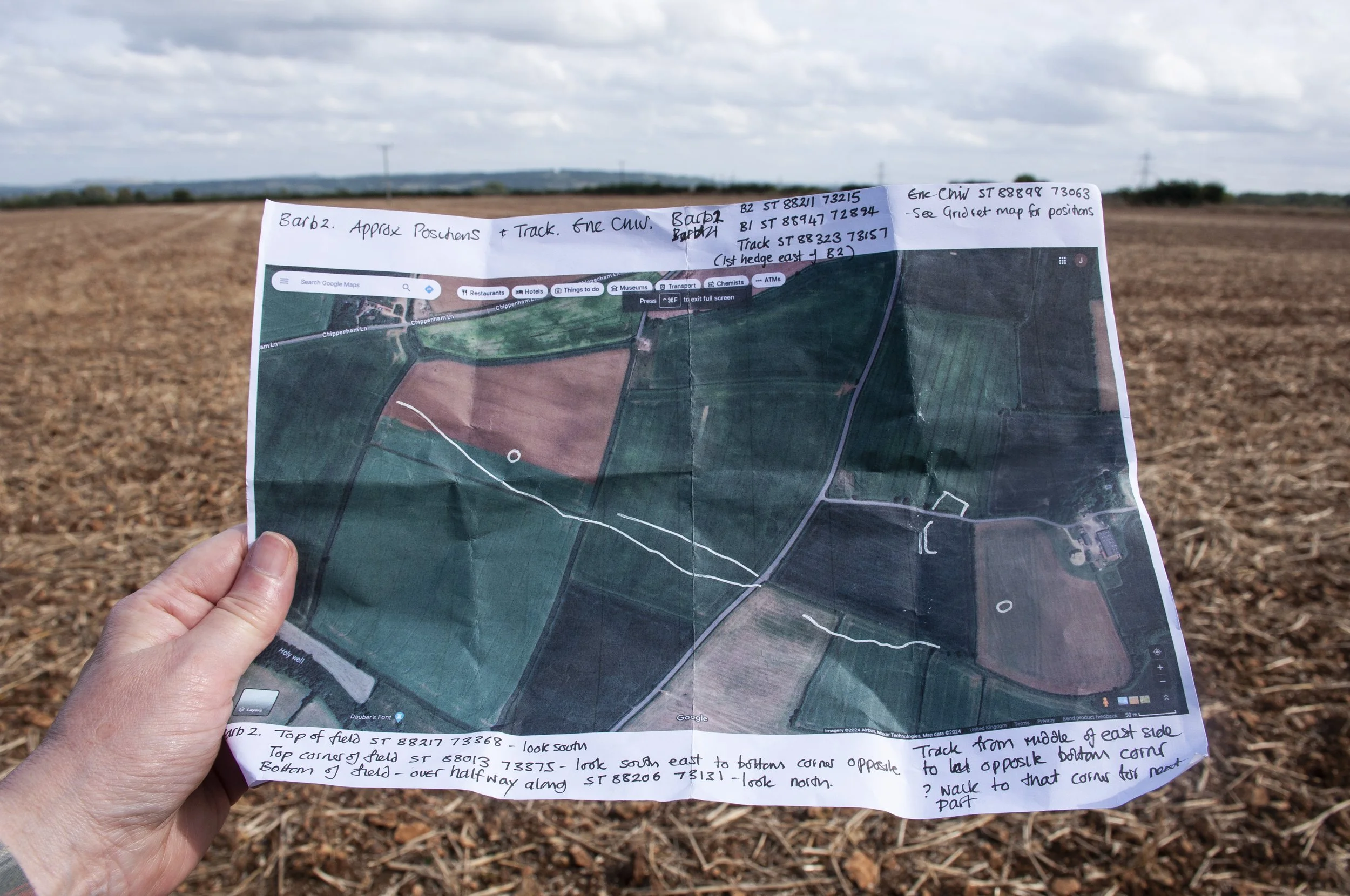
Calculating the position of the site of the Bronze Age round barrow
While on the short, eastern side of the field I examined the aerial photograph, from this position I was looking for a definite landmark on the photograph, which lined up with the small circle, green and almost perfectly round, occupying both the corner of the photograph and, though not visible there now, the corner of the field. There was a lone bush or tree on the aerial picture, on the field boundary, which also appeared on a more recent aerial photographic map, directly opposite the crop mark. I looked at the field and beyond to the hedge. There was a single bush, dark and leafy, in the same position as the one on both photographs; the crop mark would have been directly in front of it, halfway between the hedge and the mid-field telegraph pole. I concentrated on the spot and took some photographs, then walked round to the south side of the field, and took more photographs of the site. The light was changing, the low sun made long shadows. I walked back. At the field entrance, I picked up two pieces of china, once part of a sherd – now broken, still touching along the crack which separated them.
I went back to Starveall several times, to take photographs, ending up there when I had been visiting other sites. Occasionally, I encountered people on Chippenham Lane, running, cycling, walking dogs. One hot, bright afternoon, I noticed an object in the distance, it was soundless and travelling towards me at the speed of a bicycle. I observed its progress along the open lane between the banked fields. As it approached I could see that it was a vehicle, driven by an elderly man, dressed in a dark brown suit and with a white beard reaching down to his waist. He was riding a large, long, tricycle, sitting very upright, but not making much effort, so perhaps the vehicle was motorised. There was a canvas canopy over him, providing shade from the post midday sun. He drew nearer, travelling through the high summer afternoon. I stared, too surprised to do more than form an expression of greeting as he bowled along, a gleam in his eye, and receded along the lane towards Starveall, and the bend, around which he smoothly disappeared. I carried on, my afternoon enriched by the vision from the past, or possibly the future.
I returned to Starveall towards the end of the year. Summer was over. Rain had fallen heavily. At the fork in Chippenham Lane, water gushed purposefully from the drainage channel, bypassed the ditch, full already, and streamed across the tarmac, down to the lowest point on the lane below, where it formed a pool, seeping into the grass. I wanted to see if I could take a short cut up to the field where the Bronze Age round barrow had been. I found a route and set out across the mud. The ditches had been cleared of foliage and redefined; smooth edges, cut and folded over, the red brown soil around them tamped down. Already water lay within. Large pools shone brightly on the dark ground, where here too, the rainwater had not drained away. Meadow pipits lifted and dropped above me, a final flight through the cool air before the end of the day. I followed the hedge, hoping my permission extended to today. The sky was white, dull in the late afternoon light. I came to the end of the hedge and into the next field. Unexpectedly, I had entered on the short western side nearest to the site of the round barrow. The ground appeared to have been ploughed since my last visit, the furrows freshly turned. I walked along and turned the corner to continue on the longer, lower side. As I walked I picked up bits of stone and a small bone to add to my collection of objects from the site. There was a rush and a pattering of feet in the soft grass; two deer ran off into the next field, their silhouettes fragmented by the bare branches of the hedge. I carried on along the lower side, up the eastern edge, no hares this time, a red kite flying overhead, and onto Chippenham Lane, then back to the housing estate to catch the bus home.
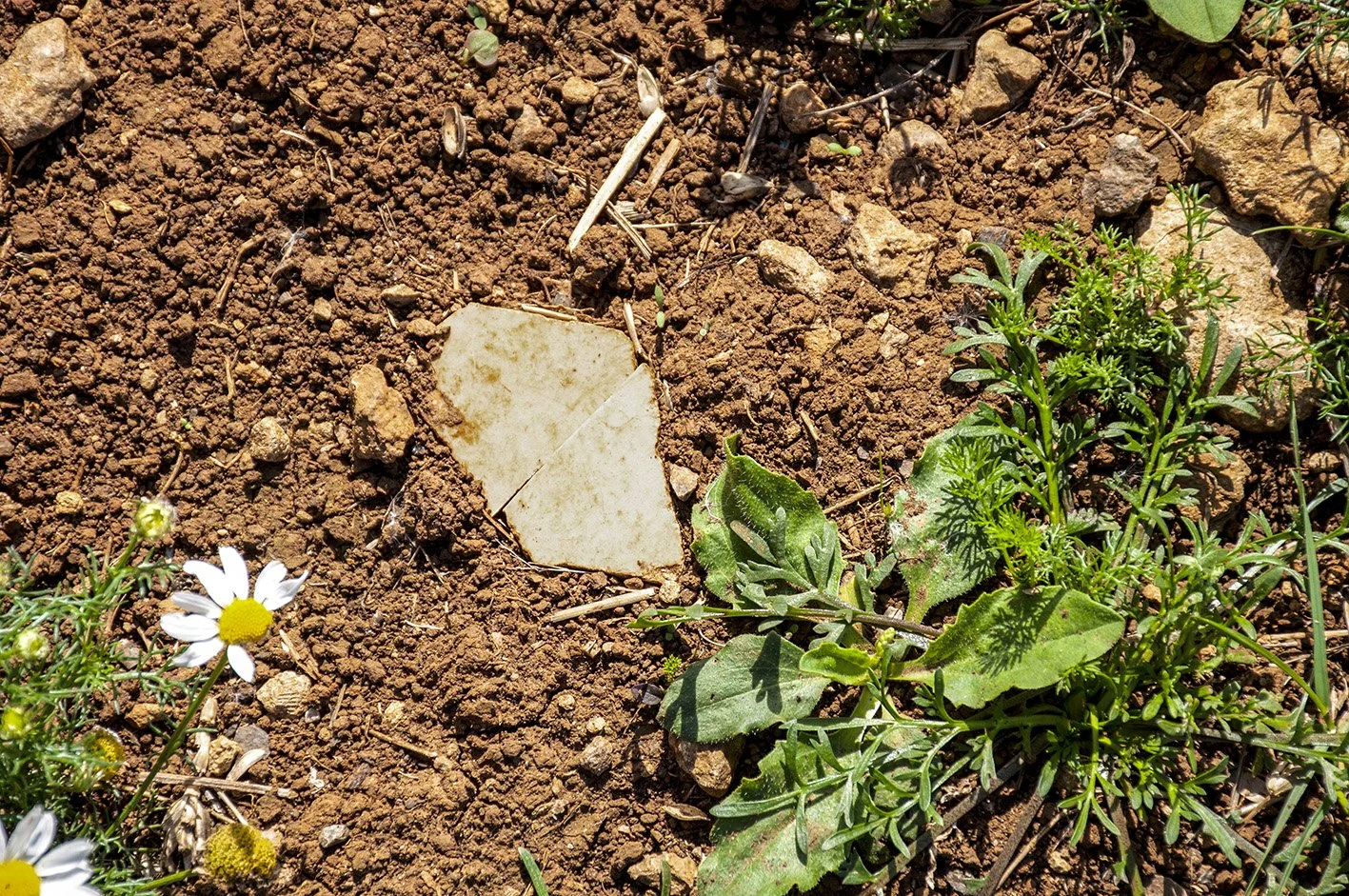
Broken china found at Starveall site