Axe, Neolithic
26th June 2024
The Neolithic axe had been found in 1968, slightly east of Cepen Park by John Tucker, a local archaeologist, who has excavated several sites around Chippenham; though deposited at Bristol Museum it is on loan to Chippenham Museum, where I had photographed it. Now, the photograph of the axe was going to the findspot. Official records gave a grid reference situated in the middle of a back garden surrounded by a crescent of houses. I hoped to position the photograph of the axe as near as possible to the grid reference, probably in front of the house in whose garden it appeared to have been found. Confusion arose when I saw further records, also official, which gave a specific address, including the number, of a different house, for the findspot. I decided that the first grid reference was a slight generalisation and planned to photograph the axe outside the specifically numbered house.
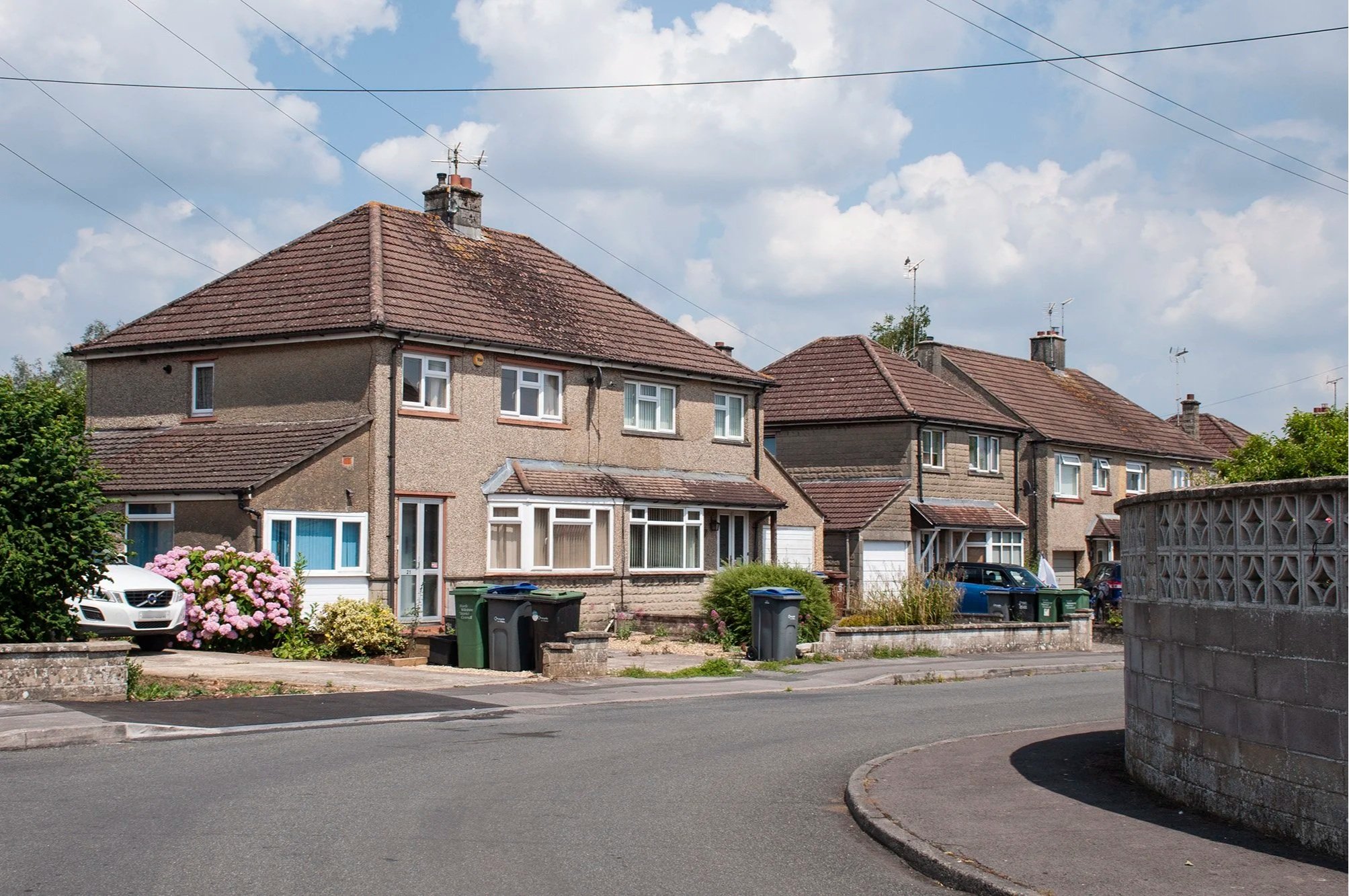
The crescent, where the axe was discovered
It was hot. Summer had arrived. I planned my route; I caught the Chippenham bus and alighted at Frogwell, from where I made my way to the small crescent. There was no breeze. The silent houses baked in the post-midday sun, upper windows open, curtains closed. Any outdoor tasks that had to be done, had been done already, in the cooler morning. Everyone was indoors, sheltering. The houses were built of a mud coloured brick with an irregular surface, some of them had been pebble-dashed the same light brown, all those facing the sun, bleached now, to a chalky brightness. They all had small bay windows and a garage attached on the side. I walked along, past hedges, privet and lilac, some pruned, others bushing out over the pavement. There was a hydrangea at the side of one of the houses, in full pink flower, pale in the strong light. Grass and dandelions grew where kerbstones met the road and next to the low brick walls enclosing front gardens. Specimen shrubs, hypericum, spirea, had been planted near to the gates; one house had a dark red acer glowing in the front plot. I looked out for the house number. When I found it I saw that there was nothing to pin the photograph on to, and no-one to ask permission regarding entering a garden or using a wall.
I tacked the photograph on to a small block of wood to keep it upright and placed it on the gritty, tarmac pavement, grey in the raking light, with the numbered house in view behind it, and lay down with my camera. It was not very satisfactory. A low breeze whisked around at ground level, and the photograph was blown over. I looked around for other opportunities. There was nowhere to place the photograph without entering one of the gardens. The hot afternoon toiled on. The pictures I had taken did not show the axe anywhere near its findspot. At the end of the school day, the air shifted. Schoolchildren appeared, walking down the middle of the road. Soon the crescent would be too busy for me to work. I rang a doorbell to hopefully speak to the owner of one of the houses about the possibility of positioning my photograph on their wall. This alerted a neighbour and I asked if he thought anybody would mind, at this point a woman appeared at the door whose bell I had rung and I explained what I wanted to do and she had no objections. Feeling more confident now that I had acquainted myself, I balanced the photograph of the axe on a low wall, with the numbered house of the findspot in view. A car and a land rover occupied most of the front garden, a yellow rose climbed up a trellis. The blinds in the bay window were pulled almost all the way down. Nearer, purple lavender grew next to some red-flowered summer plant. This was as close as I could get to where the axe had been found.
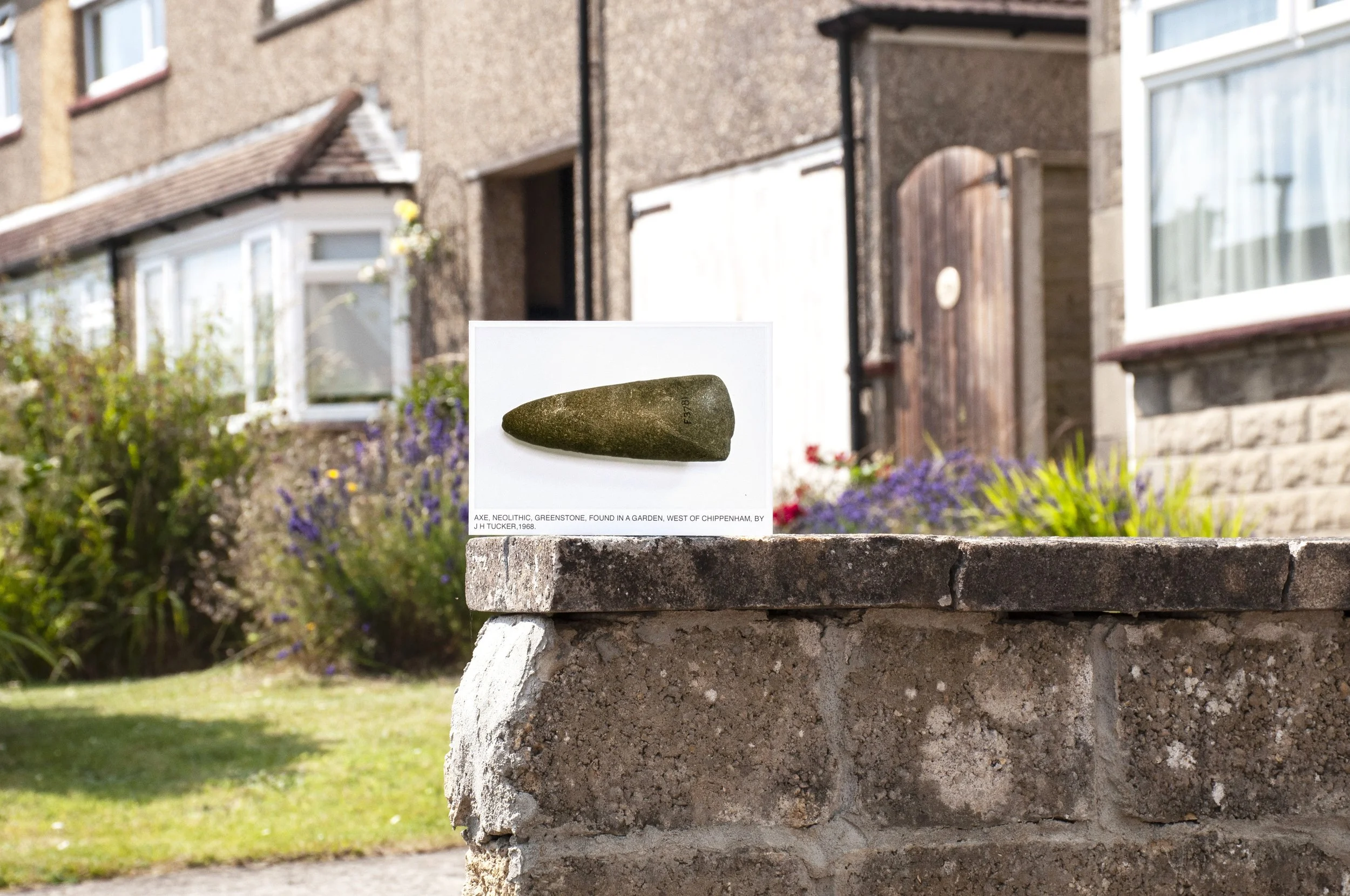
Axe, Neolithic. Findspot: crescent to the west of Chippenham
The sky was still bright, but with occasional casts of cloud. I tried different positions. The high ground had absorbed the heat of the midday sun and the pavement was still burning hot. A car came down the road and pulled into the drive where I was working, a man, the other owner of the house, looking curiously at someone so at home in his front drive. He parked the car and I explained about the project, adding that I had asked permission. Fortunately, he too, did not mind and went indoors. I finished taking photographs, packed up and walked back to Frogwell, where I caught the bus home. It was the same bus driver who had driven the bus on the outward journey. Shiny blue sun glasses with reflective lenses: “ Have a nice evening”.
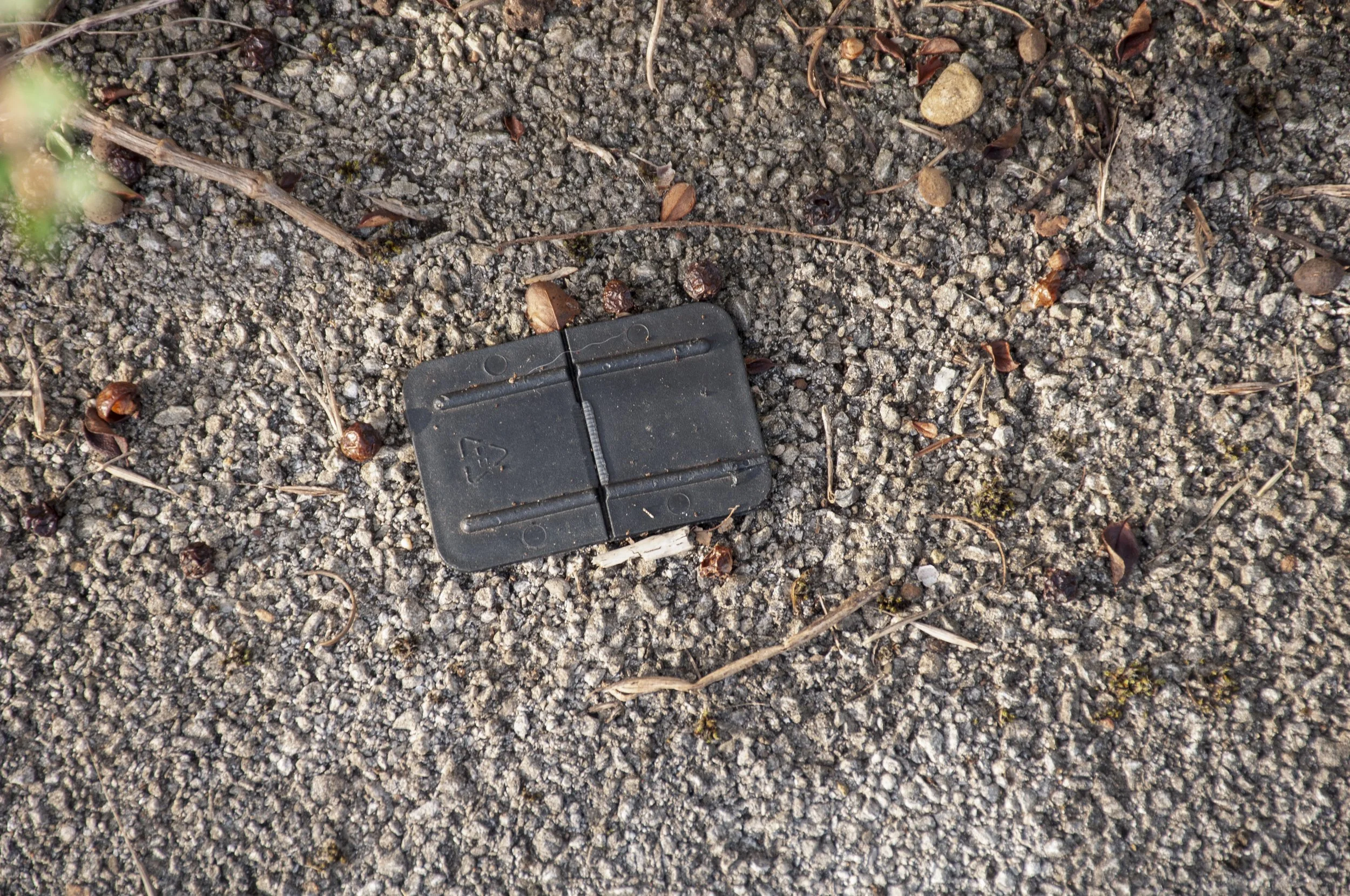
Plastic part found on the crescent
Further Information
The Axe
Photographed at Chippenham Museum, where it is currently on display, on loan from Bristol Museum. The photograph was taken to the site and photographed in front of the spot where the axe was found by J H Tucker in 1968. As nothing is known about the context of the find it is impossible to speculate as to whether the axe was dropped or deposited. J. H. Tucker was responsible for a number of excavations in the area which have revealed evidence of significant prehistoric activity in the immediate environs of Chippenham
Acknowledgements