Brooch, Plain trumpet-headed, Roman
Arrowhead, Neolithic
Brooch, Nauheim derivative, Roman
21st June 2024
It was the first batch of hot days in what, so far, had been a cool summer. I had three photographs to take to their findspots at Showell, situated south of the A4 on a thin piece of land next to the railway line. There had recently been road works in the area; the A350 had a new roundabout and roads were being widened to service new housing developments. I had communicated with one of the businesses whose premises adjoined the site and had permission to enter the fields. Access to Showell was impossible on public transport and approaching on foot meant a hazardous walk along the A350 or on a road without a pedestrian path, so I took a taxi. When I set out, in the afternoon, the temperature was high. We drove along the A350, looking for the roundabout turn-off onto Patterdown. The land around the road was revealed on account of the recent work, fences had replaced hedges, fields lay flat, pinned beneath the high, cloudless sky, visible now through the pale bars of the post and rail fencing. We left the A350 and turned into the minor road which was closed to all traffic, except for those driving to homes or workplaces. I identified the farmyard and the driver turned in and pulled around ready to drive off. A woman appeared, alerted by the sound of the taxi. I got out and explained that I had permission to go into the fields. That was acceptable. The taxi driver went off and the woman went back indoors. All was quiet now, the former farmyard settled back into the afternoon. I looked around; there were outbuildings; barns and sheds, doors wide open, shaded within, impedimenta from other business leaning against the walls. I walked across the yard and stepped over a sheet of corrugated iron, rusted and lying flat, and into the first field, identifiable to me by its irregular shape, already noted on the map. Two fields away, to the east, was the area where the finds had been discovered, ahead was the A350 and the railway line. There was a track next to the fence, which I followed, looking for a gap. The next field was much larger; spreading out towards the distant corner which was hopefully my entrance into the site of the excavation. Long grasses grew dense, standing upright with large tassels of seeds, ripening, pale brown with a purple tint. I pushed the stems to one side; there was no path, not even an animal track. Carefully I trod a bit further, parting the grasses with my arm, looking for evidence that something had passed through before me, but there was only grass, tall, up to my shoulders. There was still a long way to go and being aware that I may not even be able to get through to the site, I examined the map and decided to approach from the minor road.
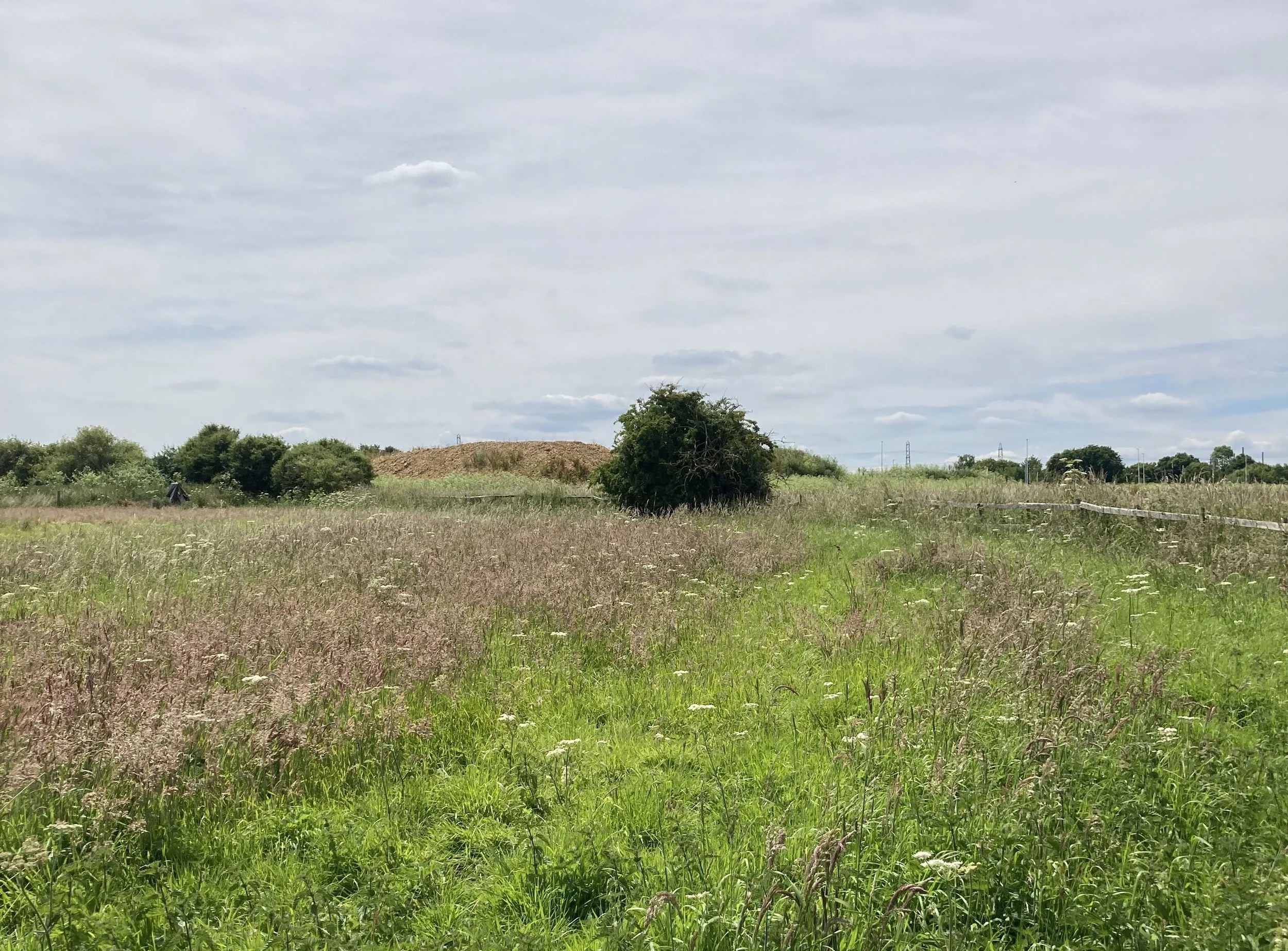
The first field, next to the roadworks
After leaving Showell Farm I passed some nineteenth century houses. Ahead of me and on the right, the pale colours and neat walls of the new houses were lined up below the sky. I walked along a newly made verge, just soil, levelled, not yet seeded with grass. Then a tarmac path, black, sweating in the heat, echoing the circuit of a large roundabout. Mesh barriers enclosed the building site, men in safety helmets, moving around. The houses were not occupied, there were just walls, windows, roofs – pale beams exposed – porches with small canopies supported by pillars. Sapling trees grew thinly alongside the pavement, but no flower beds had been planted yet. When planning my journey I had used Google Street View so I knew that somewhere along the hedge, on my left, there was a break. The new path came to an end. Grasses fanned out over the road. The hedge was tall and thick, at the height of its summer growth, but there was the inlet; grass and nettles had been trampled down, forming a route, up the bank, down into the ditch and up the other side, where the hedge thinned out. I climbed through; a broken yellow mug lay on its side, bright in the damp shade of the hazel and hawthorn. Pushing aside branches, I entered the field. The grass in this field was not so high or so dense, dock grew here and there, seeds ripening; there were a few buttercups and some yellow vetch, but mainly different species of grass, some short and a rich green among the waving plumes – also pale and tinged with purple, bunches of seeds in clusters. Ragwort, too, tight flower buds not yet open. On my right there was fencing, grass and cleavers growing up, marking out a plot where the earth had been levelled. I followed a faint path running parallel to the fence, and there was the site, stretching out in front of me, secluded by the railway embankment, tall with shrubby trees, and the small mound on which I stood, it was a private place. This was where ring ditches had been found by Cotswold Archaeology in 1999. The archaeological reports indicated that there had been more than one application for planning permission for this piece of land. Preliminary excavations had been made but the plans had been abandoned and though the small plot on my right seemed to have been prepared for some kind of development, this field was, as yet, unspoken for.
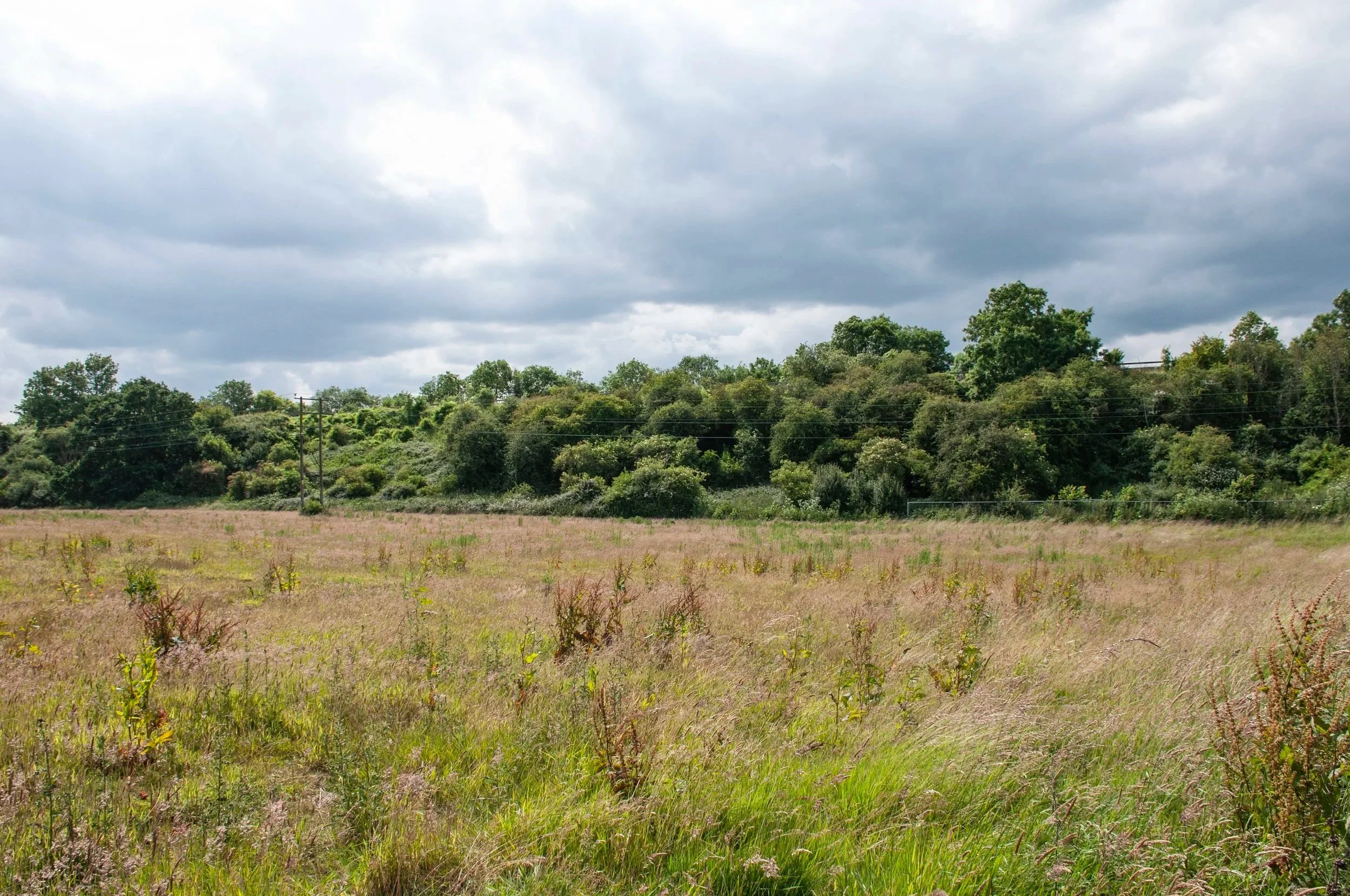
Site of the findspots at Showell
The first item, a Roman brooch, a plain trumpet-headed one, had been found in a Roman ditch; I had decided to place the picture in the centre of the strip of land once occupied by the ditch. Here, almost at the lowest part of the slope, with the railway embankment rising up, the ground was mainly populated with marsh grasses, thick, rounded stems, shooting out in clumps, still verdant from the damp conditions, despite the heat. I found the correct grid reference and placed the photograph on the grass and photographed it there. Buttercups pressed up against the image and blades of grass interrupted the text. I looked around, scanning the field and the boundaries; I had permission, but did it extend as far as this piece of land? I listened, not wanting to hear “Excuse me…” or “ Can I help you?”, a sign that a landowner, unfamiliar with my request for access, was approaching. I heard nothing but the grinding of mechanical diggers, the rush of passing trains on the line above me and the song of birds in the nearby hedgerow – some short fragments, unidentifiable tunes, and the cheap tin whistle of the black cap.
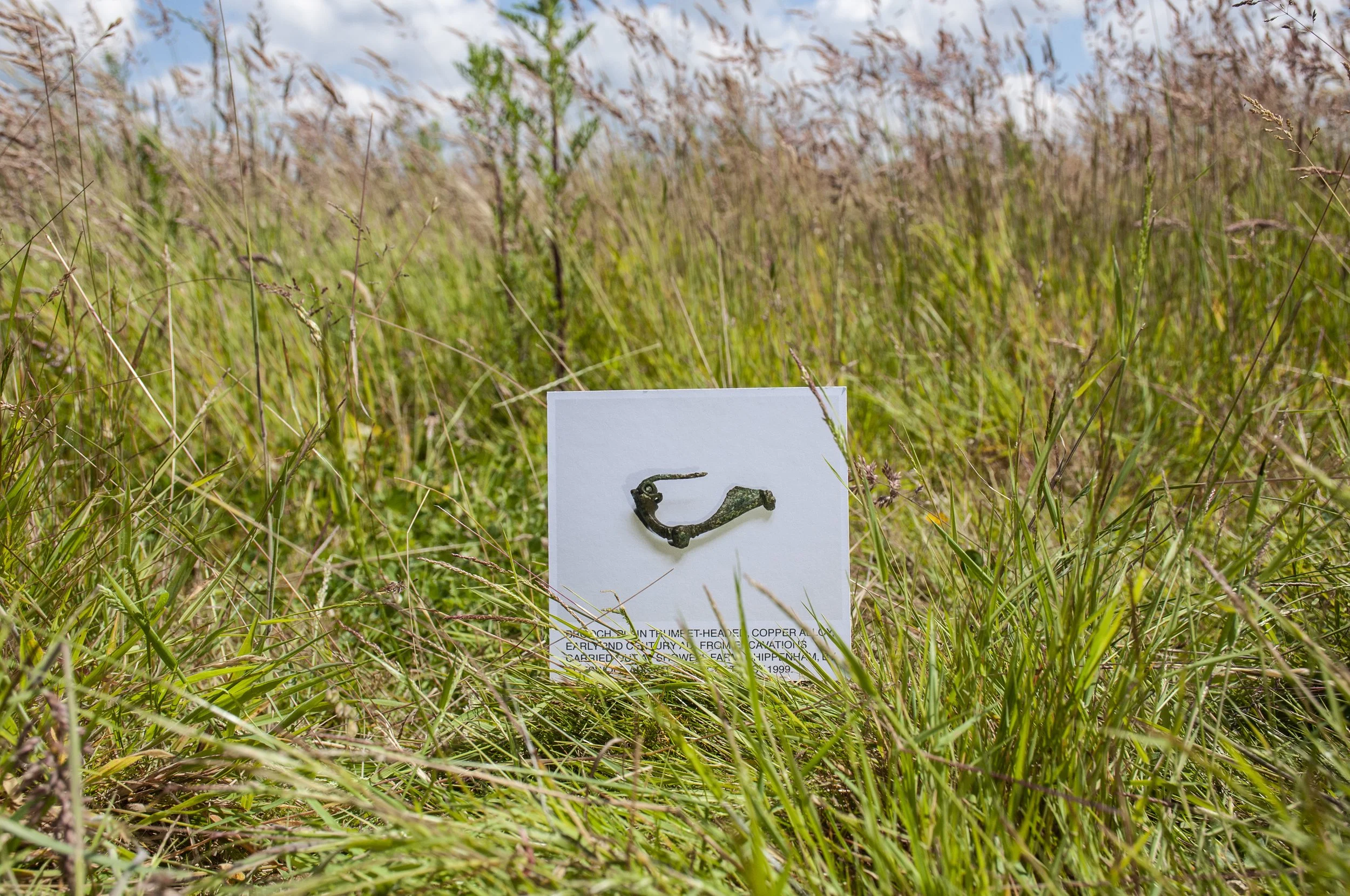
Brooch, Plain Trumpet-headed, Early 2nd century AD. Findspot: Showell Farm, Chippenham
I moved on, ready to take the next photographs, of a Neolithic arrowhead and another Roman brooch. I found the grid references but the grass grew very long in the lowest corner of the field. There was a post, pine, painted red, about 3 feet high, the cut marks of the saw showing through the single coat of paint. I fixed the picture of the arrow-head onto it so that the site where it had been discovered was directly behind it: a ring ditch heavily truncated by a Roman fence line – it was at the confluence of these two that the arrow head had been excavated. I took the photographs then set up the other photograph of a brooch at a different angle, with the site of the Roman ditch where it had been found immediately behind it. It was very hot. I was glad to enter the shade of the trees growing up the embankment to check my photographs; on one occasion I heard the delicate picking of some small creature, walking through the dry undergrowth, disturbed by my coming and going but in no hurry to get away. Back out in the afternoon sun, flies landed on the board with the picture on it; I whisked them away with a long blade of grass. All around me shoulder-high grasses stood, not moving in the still air of the afternoon, leaning slightly, long panicles bearing seeds already formed, adding a rosy cast to the foliage of the field. I noticed a flattened bed of grass pressed into a saucer shape, possibly moulded by the body of a deer, as it lay up in the day time, hidden amongst the tall stems. From where I worked the field sloped up to meet the sky, a wooden telegraph pole interrupting the horizon.
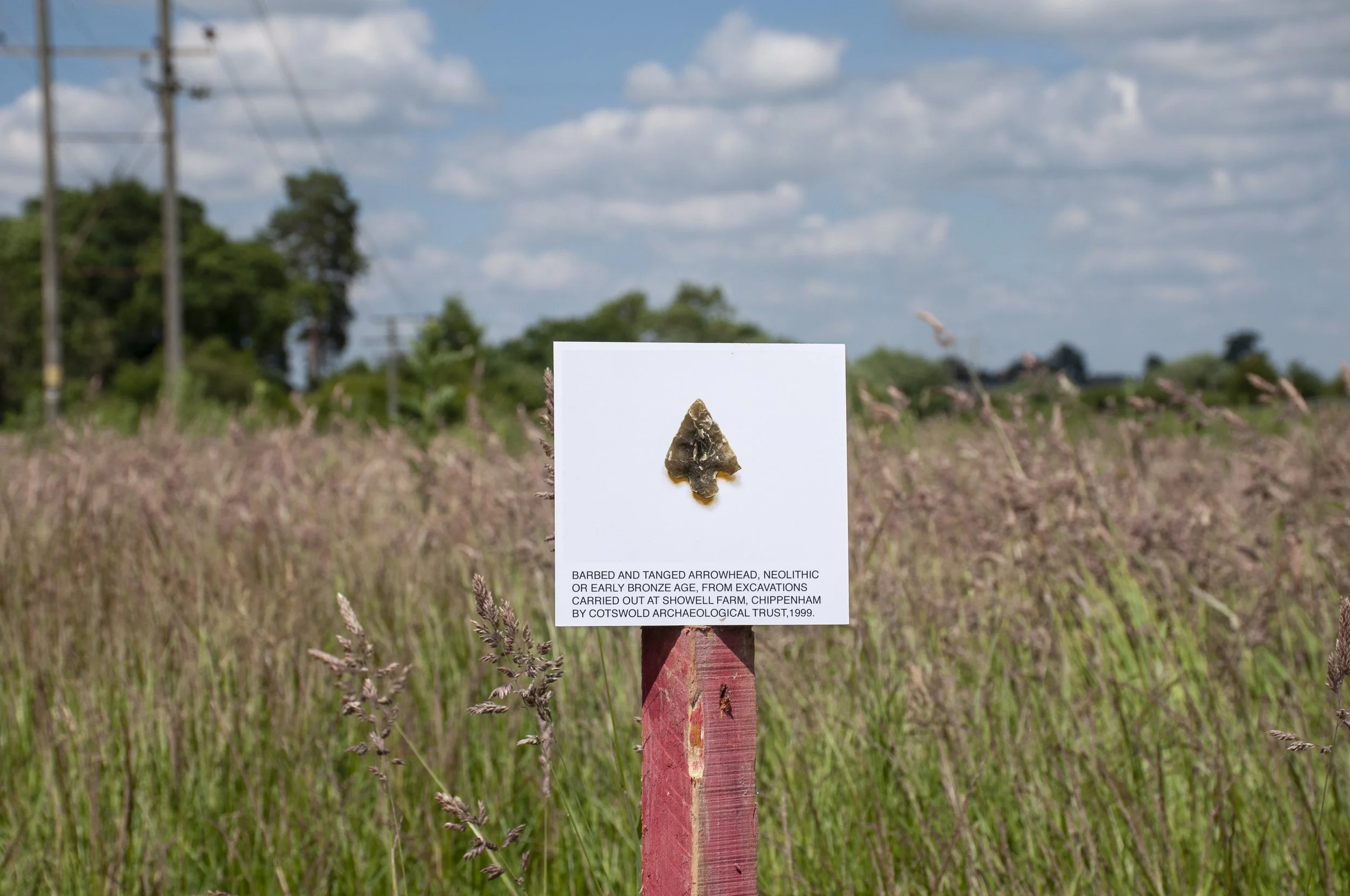
Barbed and tanged arrow head, Neolithic or early Bronze Age. Findspot: Showell Farm, Chippenham
I finished taking pictures, packed up and decided to walk to the bus stop via Patterdown hoping that it would be open to pedestrians for its whole length, but even from a distance I could see, shimmering in the heat haze, figures wearing hard hats, orange jackets blurred in the brightness, moving slowly in the heat, and barriers in the area where building work was still in its early stages. The barriers went right across the road: there was no way through, no pedestrian gap, not even an unofficial one. I decided that I would have to reach the A4 via Saltersford Lane, not a good route on account of there being few pavements and in some parts, no verges. I turned and walked back. Just before the railway bridge, there was a frog, damp and shiny, glistening on the gritty roadside. I placed it in a nearby garden, in the shade next to a pond, then I went under the bridge, up Saltersford Lane, sidestepping along the vergeless road, and along to the bus stop opposite Sainsbury’s.
22nd June 2024
The next day I realised that I had made a mistake and photographed the picture of the first brooch twice. I had to return. Now I knew where to go and did not need to waste time with my initial field exploration. I took a taxi directly up Patterdown, access only, and to avoid any questions got out before the gap in the hedge. It was just the same as the day before; I climbed in and out of the ditch and into the field and walked along the fence line, feeling a sense of familiarity now, and repeated my actions of the previous day, but this time paying attention to the images. The same trains came by at the same times; a yellow goods train, passenger trains.
I took the photographs, and this time identified the bird songs: blue tit, robin, chiff-chaff and thrush. It was not quite so hot and therefore easier to work. The grasses swayed in a breeze, moving across the photographs. When I had finished I packed up, walked back up the field, to the gap in the hedge, through nettles, brambles, cow parsley and stepped out on to the road. It was strangely quiet on account of the road being closed to traffic. It was also Friday afternoon, some entropy had set in; the building site lacked the industry of the previous day. I went under the bridge onto Saltersford Lane, this time turning left to avoid the more hazardous route, walking past Queensbridge Cottages. I was aiming to walk in the direction of the A4 but I lost my way on the Hill Top estate and did a double circuit of a small pond which remained, surrounded by new houses, on a network of winding residential roads. Eventually I found the correct turning and was soon on a familiar route which led down to the main road where I could wait for the bus.
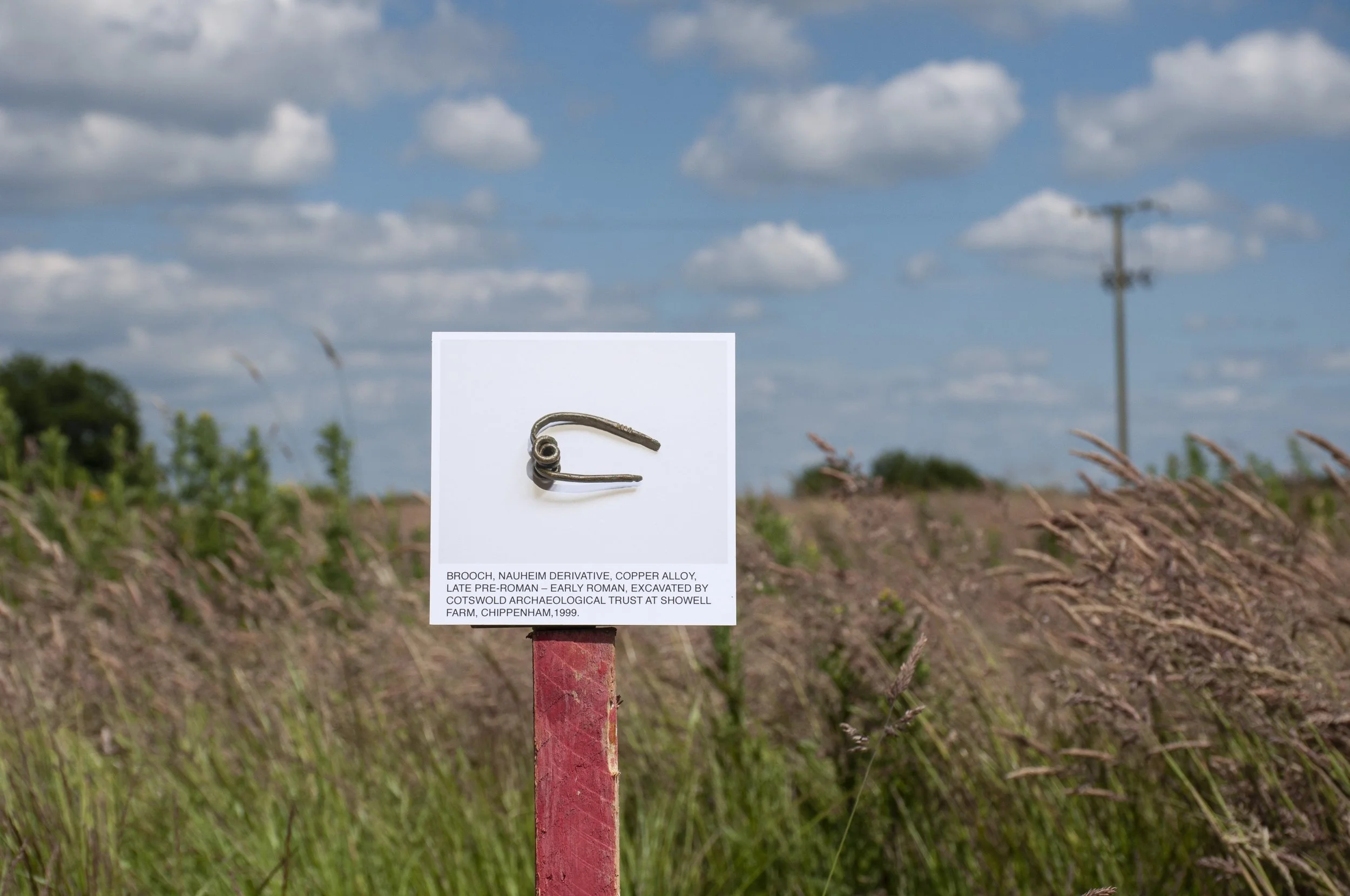
Brooch, Nauheim derivative, late Pre-Roman – Early Roman. Findspot: Showell Farm, Chippenham
I returned three weeks later to pick up the yellow mug, to add to the collection I was making of objects found on the sites which I had visited. I looked into the ditch, but the mug was gone from the place where I had noticed it, just before the path through the ditch emerged into the field. I assumed that it had been disturbed by people walking through and scuffed away. I wandered into the field, which had been mown and now had a neat cropped horizon. I was looking for something else, but there was nothing there. Then as I went back down the ditch, I saw the mug, almost out of sight, amongst the nettles and some early bramble flowers. Another plant grew next to it, the backs of its leaves turned up, showing the veins, a trim of soft spikes on the outer edges. Bindweed, no flowers yet, trailed along.
November 2024
Later still, in November I returned briefly to the field. I had also begun collecting stones, possibly indigenous, or imported, from the sites and though I had picked up the yellow mug I did not have a stone from the Showell field. This time Patterdown was open to traffic and the road was busy, with lights controlling some of the flow on account of road works connected to the developments. As I approached the field that I was hoping to enter I saw that the small field that cut into it, which had been fenced off on my last visit, was being dug over. I found the gap in the hedge, entered the field and began to search for a stone. The grass was short but dense and there were no stones to be found. The sound of diggers was all around, hooting as they shunted back and forth. Not only the small field, but the adjacent field, the site of the ring ditches, where I had taken photographs earlier in the year, was being developed. I followed the hedge and found some stones in the dry earth below the hawthorn trees.
The field seemed more open, less secluded, a large vehicle had been driven around since I was last there, churning deep ruts out of the grass and exposing clods of earth, water lay in the channels, held by the clay soil. Dim in the mud, half hidden, were small pieces of flint, I crouched and leaned over to lift a white one with a dark grey band out of the shallow rivulet. There was another piece – a dull rust colour, its rounded end and ridged surface showing above the mud. Around the ruts the earth had been folded back. I could see the underside of the grass sods; here too, small stones were exposed; I picked one, milk white and pale brown, from amongst the worm casts on the dryer earth. By now I was near to the site of the ring ditches, also traversed by the large-wheeled vehicle. I followed the tyre tracks up the slope and then walked back to the gap in the hedge and made my way down to the A4 and the bus home.
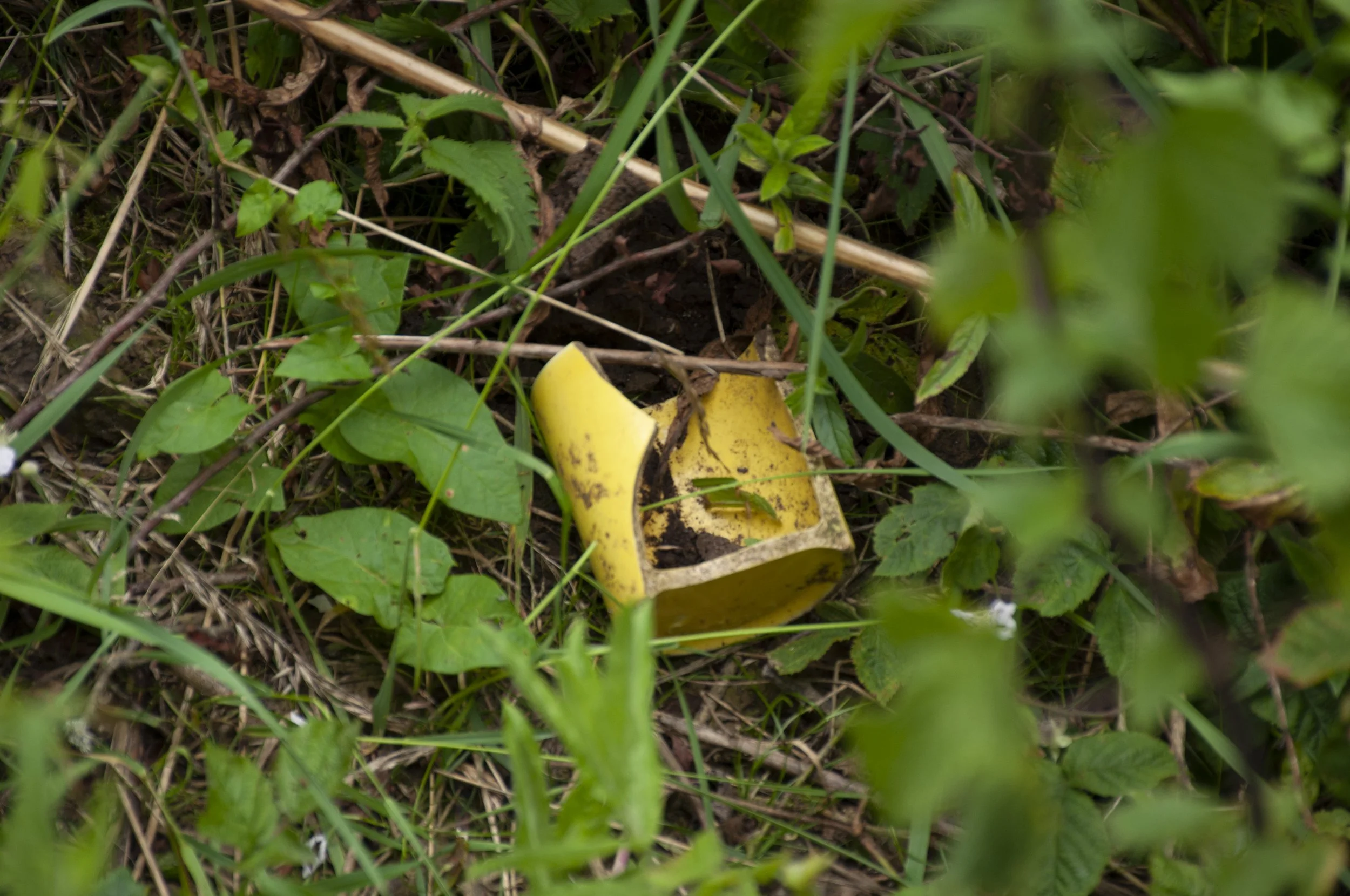
Yellow mug, broken, found at the entrance to the site
Further Information about the Finds
The Trumpet-headed Brooch
Photographed at Chippenham Museum, where it is part of the collection. The photograph was taken to the site and placed in the spot where the brooch was excavated by Cotswold Archaeological Trust in 1999, in advance of a development which was abandoned. The brooch was found in a ditch, a subdivision of an Early Roman field system and was, almost certainly, dropped by the owner. Annette Hancocks and Richard Young suggest, in their article for Wiltshire Archaeological and Natural History Magazine, that the Roman finds on the site are indicative of “a small-scale farmed landscape” with a settlement to the north-west of the field system which, by the 3rd century AD, was uninhabited.
Acknowledgements
Thanks to Alan Fuller, Exhibitions and Collections Officer, Chippenham Museum
Photographs published online with the kind permission of Chippenham Museum
References
Cotswold Archaeology, 2003. Land at Showell Farm, Chippenham, Wiltshire. Post excavation Assessment and Updated Project Design. 1506. ref. 03135
Young, R and Hancocks, A., 2003. Early Bronze Age ring ditches and Romano-British agriculture at Showell Farm, Chippenham. Excavations in 1999 by Richard Young and Annette Hancocks with contributions by Wendy J. Carruthers, H.E.M.Cool, G. B. Dannell, Teresa Gilmore, Lorrain Higbee, Robert Hopkins and E.R. McSloy. Illustrations by Lorna Gray, Peter Moore and Bryony Ryde. Wiltshire Archaeological and Natural History Magazine Vol.99, 10-50
Heritage Gateway reference for the Romano-British settlement, Showell Farm: MWI5228
The Neolithic Arrowhead
From the collection at Chippenham Museum where it was photographed. The photograph was taken to the site where the arrowhead was excavated by Cotswold Archaeological Trust in 1999 prior to a development which was abandoned. The arrowhead was found in a ring ditch, which along with another ring ditch on the site, has been interpreted as a small round barrow. The position of these two barrows on high ground close to the River Avon, and dating of finds made in the other ring ditch, supports the suggestion that these are funerary mounds dating from the 3rd millennium BC. Given the funerary nature of the ring ditches there is a possibility that the arrow-head may have been deposited. Richard Young and Annette Hancocks, in their article for Wiltshire Archaeological and Natural History Magazine regard the discoveries “as part of an increasingly dense pattern of Late Neolithic and Early Bronze Age activity in the Chippenham area”
Acknowledgements
Thanks to Alan Fuller, Exhibitions and Collections Officer, Chippenham Museum
Photographs published online with the kind permission of Chippenham Museum
References
Cotswold Archaeology, 2003. Land at Showell Farm, Chippenham, Wiltshire. Post excavation Assessment and Updated Project Design. 1506. ref. 03135
Young, R and Hancocks, A., 2003. Early Bronze Age ring ditches and Romano-British agriculture at Showell Farm, Chippenham. Excavations in 1999 by Richard Young and Annette Hancocks with contributions by Wendy J. Carruthers, H.E.M.Cool, G. B. Dannell, Teresa Gilmore, Lorrain Higbee, Robert Hopkins and E.R. McSloy. Illustrations by Lorna Gray, Peter Moore and Bryony Ryde. Wiltshire Archaeological and Natural History Magazine Vol.99, 10-50
Heritage Gateway reference for the Bronze Age round barrow where the arrowhead was found: MW15219
The Nauheim derivative Brooch
Photographed at Chippenham Museum where it is part of the collection. The photograph was taken to the site and photographed in front of the spot where the brooch was excavated by Cotswold Archaeological Trust in 1999. The brooch was almost certainly dropped by the owner, it was found in a Roman ditch which defined a trackway cutting across the site, with a field system on both sides. Cotswold Archaeological Trust, in their excavations in 1999, found evidence of Roman activity in the area, and speculated that the site was on the perimeter of an early Roman settlement, situated to the north-west, which was abandoned by the 3rd century AD
Acknowledgements