Coin of Nero, Roman
Pin and two brooches, Roman
Pottery Fragments, Medieval/Post-Medieval
6th June 2024
Though Sainsbury’s, McDonalds and Cepen Park South cover a large area, with sites such as a Neolithic pit, being enclosed somewhere below Sainsbury’s car park, it is still possible to locate precisely some of the findspots; three of these were around McDonald’s restaurant near the roundabout. I caught a bus to Sainsbury’s and walked along the road to McDonalds.
The sky was pale, there was no breeze; the early summer leaves hung down from the trees, dull in the still air. Traffic circled the roundabout, a continuous passage. The restaurant was situated beyond a lawn, with parking and a drive-through behind and along the side. I went in to ask if I could take photographs and was told that this was acceptable as long as they did not feature staff, customers or buildings. I said that a small portion of some buildings might be on the edge of the photographs but was given permission to go ahead.
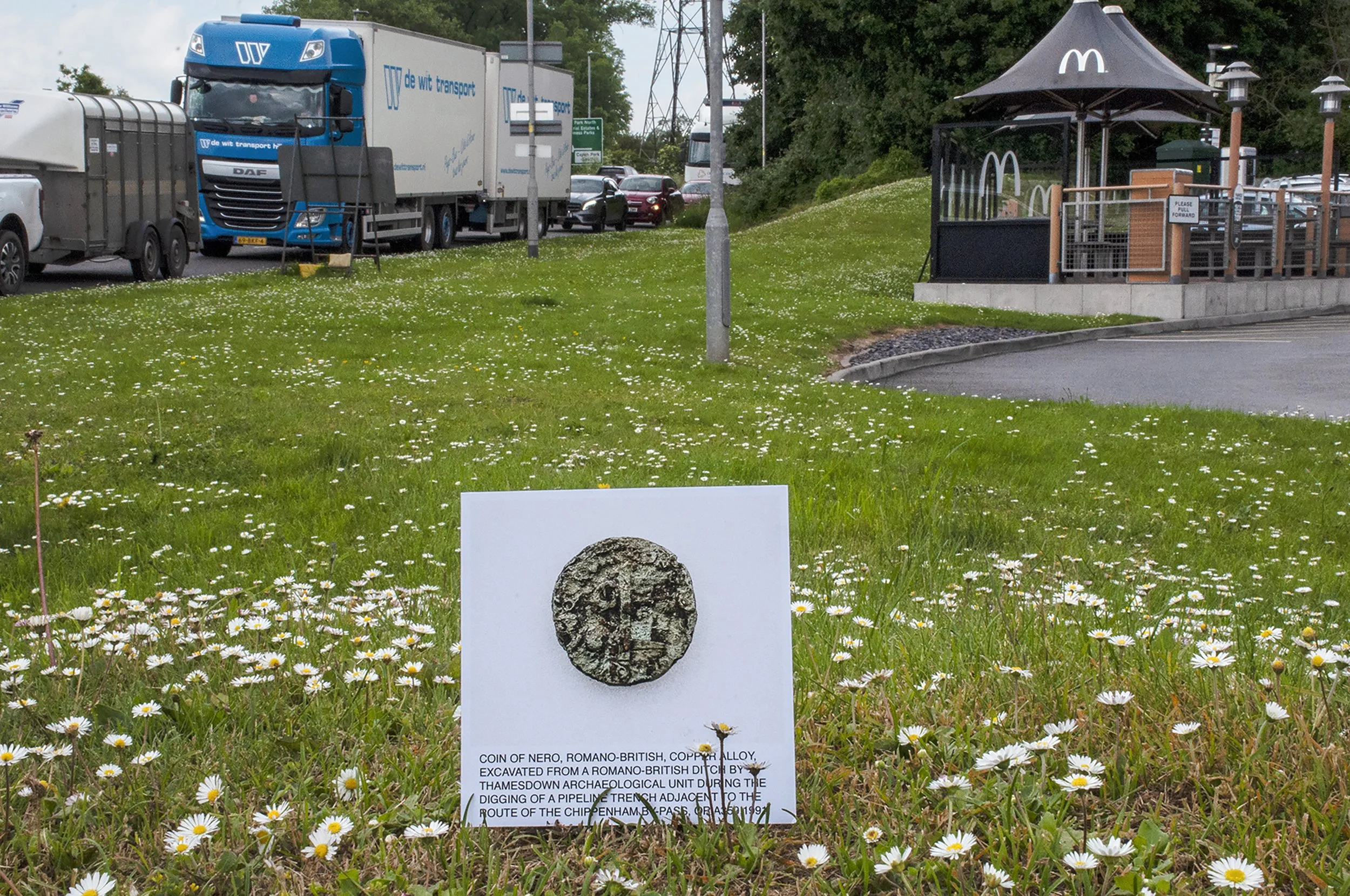
Coin of Nero, Romano-British. Findspot: Romano-British ditch near McDonald’s Roundabout, Bath Road, Chippenham
I had a photograph of a Roman coin of Nero which I was hoping to place at or near to the findspot of the coin. Using GPS I found the spot on the apron of grass in front of the restaurant and tacked the photograph on to the small block of wood which would keep it upright, then positioned it on top of a mound, behind a banner advertising McDonald’s products. Daisies and blades of grass obscured some of the text. In the background, pylons made their connection across the land, every kind of vehicle powered by, on its own purpose. I tried the coin picture in a few different places then moved on to the next photograph, more Roman finds, two pins and a brooch, delicate structures, the copper alloy turned green. The photograph was a tall slim object and I leaned it against the kerb, but had to break off when people entered the drive-through; instead, I tacked it onto the window of an outdoor eating area – the silver M of McDonald’s on the glass, wooden tables within. Lastly, I attached it to a metal post, in front of a view of the road, wide, and heading south towards the Dorset coast.
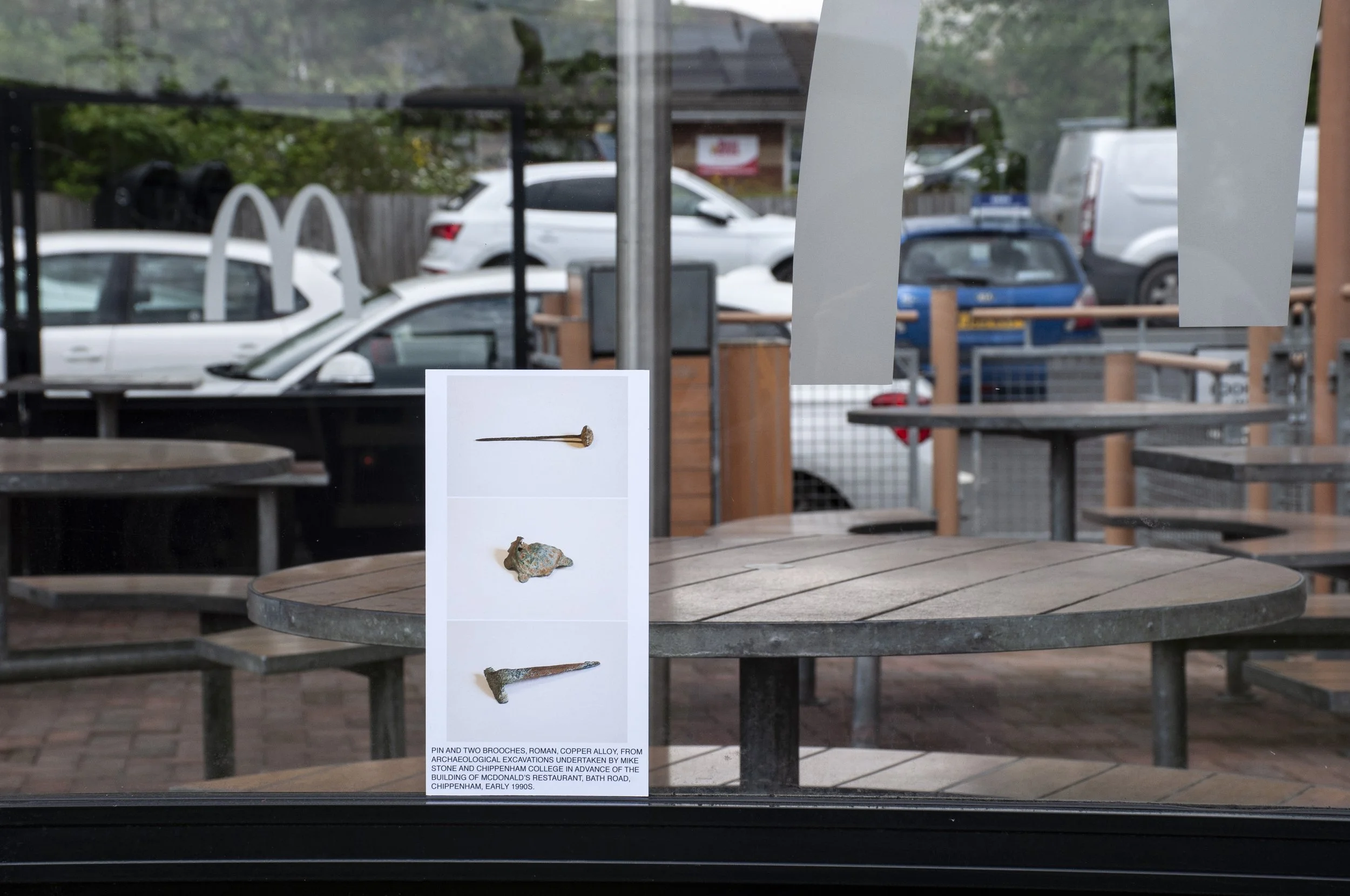
Pin and two brooches, Roman. Findspot: McDonald’s restaurant site, Bath Road, Chippenham
My next photograph was of fragments of pottery, rim sherds and handle fragments, medieval and post-medieval. The small fragments were all coloured blue and white, stripes and checks. The decorations had a contemporary look to them. I located the findspot using the grid reference; it was close to several pieces of car park furniture to which I could attach the photograph. I positioned it on a rubbish bin, a fence with brambles growing over it, on the grass, and finally, I tacked it on to the back of a unit for recharging electric cars. It was four o’clock in the afternoon, people nosed their vehicles in and out of the car park, collecting their orders or parking and going inside to eat. This was the last image of the day. I went in to say thank you and showed some of the pictures of the finds. The staff were almost the first people to see the pictures and I was happy to be showing them near the site where they had been found. I crossed the road and caught the bus home.
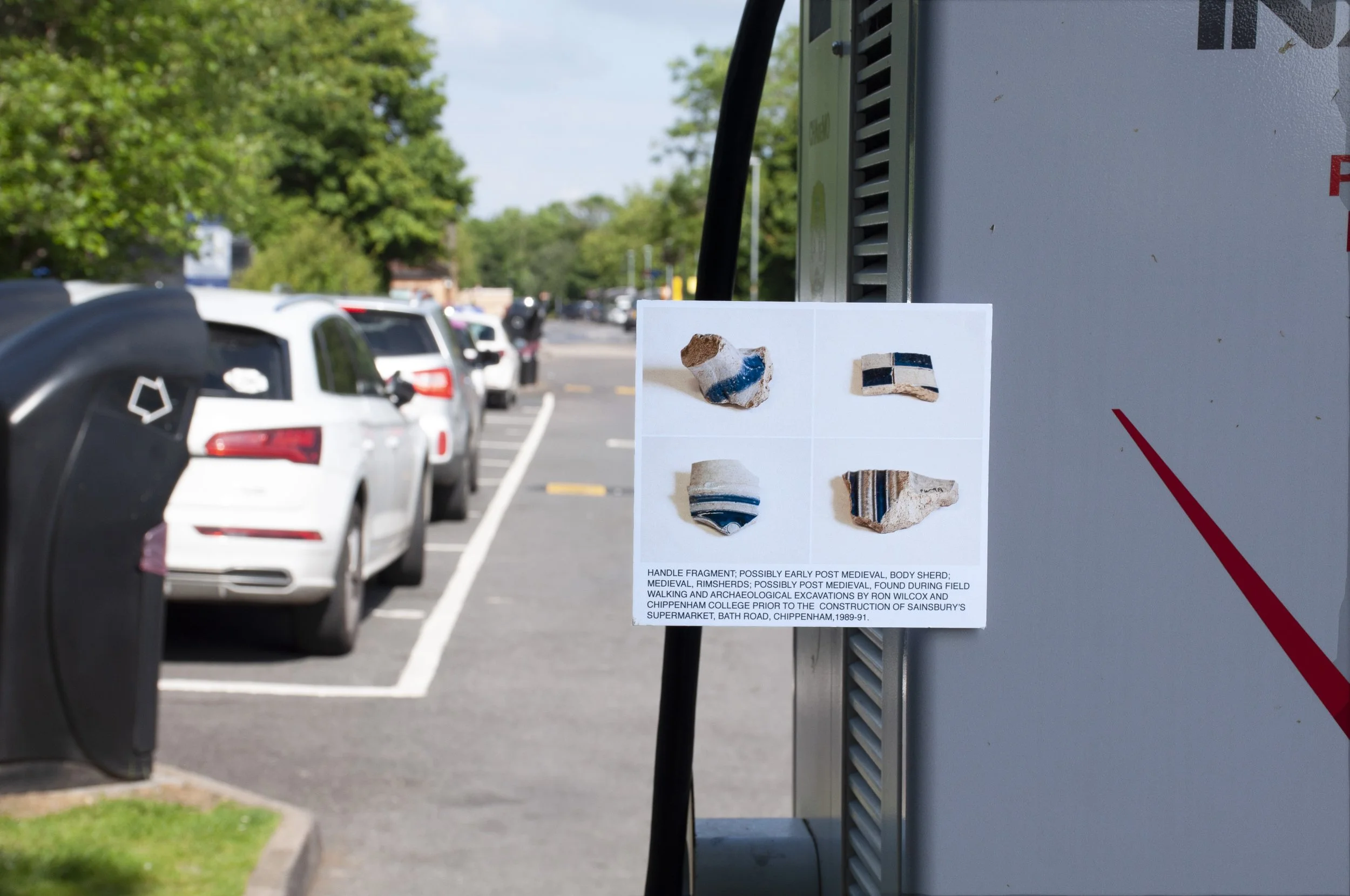
Handle fragment, possibly early post-medieval, body sherd medieval, rim sherds possibly post-medieval. Findspot: Sainsbury’s Site, Bath Road, Chippenham
I had begun picking up finds from the sites that I visited. From the McDonald’s site I took a purple-grey stone, from chippings imported to fill in the space around the various machines, posts and pillars which had been put up to service the site. I also took a short metal pipe, made up of different sections, from the side of the A350.
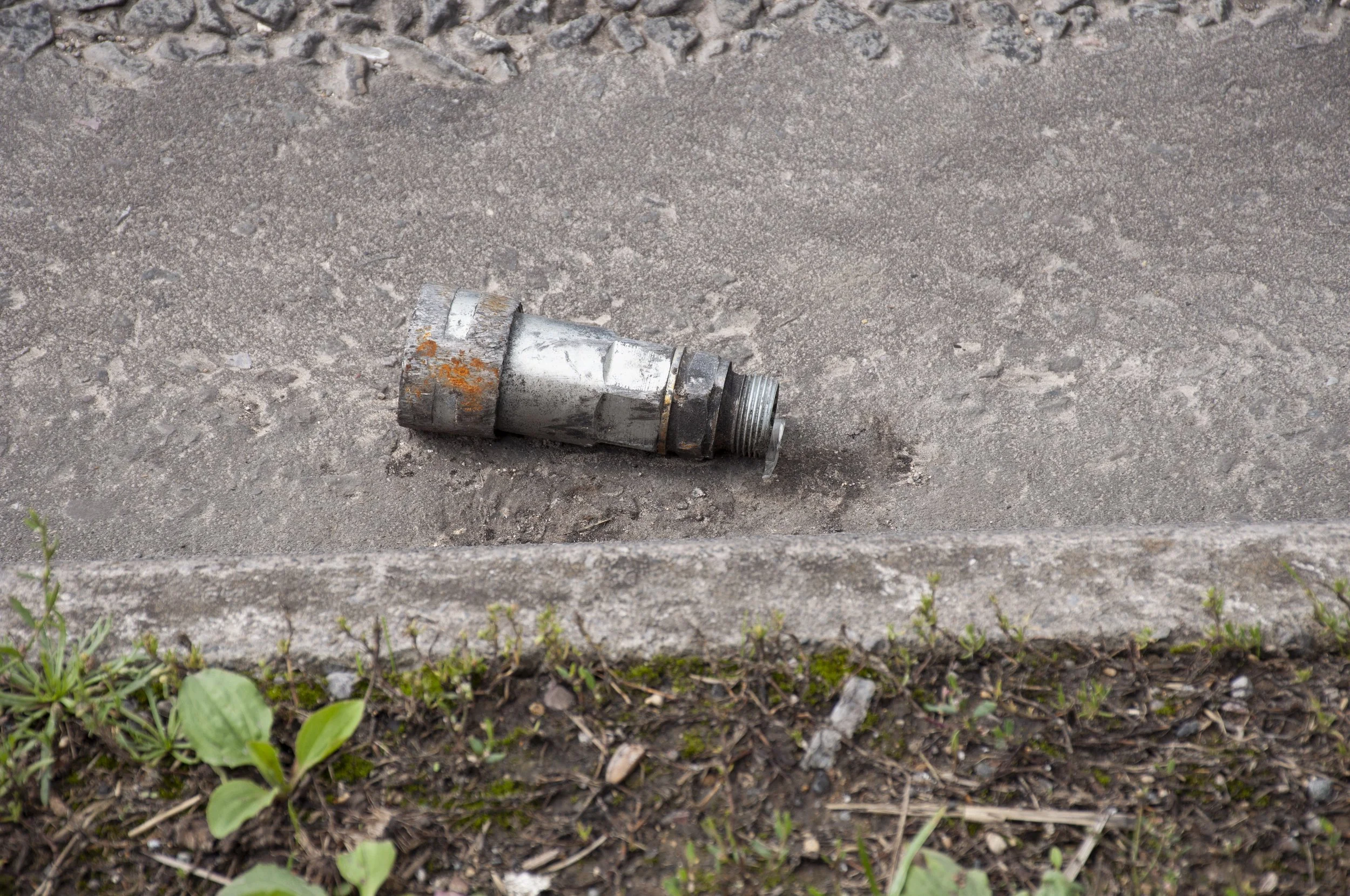
Vehicle part, found on the McDonald’s site
Further Information on the Finds
The Coin of Nero
Photograph courtesy of Wiltshire Museum, Devizes, where the coin is deposited. The photograph was taken to the site and positioned in the spot where the coin was found in 1991 by Thamesdown Archaeological Unit during the digging of a pipeline trench adjacent to the Chippenham by-pass. The coin, which was probably dropped, is a reflection of Roman activity in the area of the roundabout as suggested by Wiltshire Rescue Archaeology Project, who refer in their report of 1987-88, to the possibility of a Roman settlement in the area. J.Gregory and A.Miller of Thamesdown Archaeological Unit also noted a considerable amount of Roman pottery just north of the roundabout when the initial road-scrape was made for the bypass in 1991
Acknowledgements
Photograph published online with the kind permission of Wiltshire Museum
References
Devizes Museum Accession Register 1992.22
Wiltshire Rescue Archaeology Project 1987-1988
Thamesdown Archaeological Unit, 1991. Chippenham Ring Main West. An Archaeological Report on a Watching Brief. P.Jeffrey
Thamesdown Archaeological Unit, 1991. Excavations Chippenham Western By-Pass. First Road Scrape. A Brief Investigation. J.Gregory and A.Miller
Heritage Gateway reference for the Romano-British ditch where the coin was excavated: MWI223
The Pin and Two Brooches
From the collection of Chippenham Museum, where the pin and brooches were photographed. The photograph was taken to the site and placed in the spot where the items were excavated in the early 1990s. These items were probably dropped and lost. There is the suggestion of a Roman settlement in the area; a high accumulation of Roman pottery was found in the field west of the roundabout by Wiltshire Rescue Archaeology Project in 1987-1988 and in 1991 Thamesdown Archaeological Unit, investigating the groundwork for the new by-pass, also found a considerable amount of Romano-British Pottery in the area adjacent to the roundabout. A recently discovered report, from 1990, by Wiltshire Rescue Archaeological Project, who were investigating the Sainsbury’s site, also mentions, amongst other things, a quantity of Roman pottery and a ditch
Acknowledgements
Thanks to Alan Fuller, Exhibitions and Collections Officer, Chippenham Museum
Photograph published with the kind permission of Chippenham Museum
References
Chippenham Museum Collection Database.
Wiltshire Rescue Archaeology Project 1987-1988
Wiltshire Rescue Archaeology Project 1989-1990
Thamesdown Archaeological Unit, 1991. Excavations Chippenham Western By-Pass. First Road Scrape. A Brief Investigation. J.Gregory and A.Miller
The Pottery Fragments
Photographed at Chippenham Museum, where the pottery is held. Found by Chippenham College Archaeology Department and Ron Wilcox prior to the construction of the Sainsbury’s supermarket in 1991. The fragments were probably from pots which had been discarded or broken. In 1991 when Thamesdown Archaeological Unit were excavating near Derriads Farm, to the north of Sainsbury’s, they found a quantity of medieval pottery which suggested that the area was part of an “important medieval settlement site” Most of the pottery found came from the 13th and 14th centuries and the report concludes that “the quantity of pottery suggests that the earthworks at Derriads Farm are indeed the location of the settlement known in AD 1167 as “Durhirda". Given their proximity to this site it is likely that the medieval handle fragments, and sherds represent domestic rubbish from the same period
Acknowledgements