Broken Flint Scraper, Mesolithic
Flint Scatter, Mesolithic
Pottery Sherd, Roman
5th June 2024 First Visit
I set out on a cool, early summer afternoon. I had photographs of a Mesolithic flint scraper, and a flint scatter from the same period, both found circa 1989 during fieldwalking carried out prior to the building of Sainsbury’s supermarket on the Bath Road. I caught the bus and disembarked at Chequers on the A4; the bus stop was in a lay-by, thought to be part of an earlier Chippenham to Bath road. Traffic passed. Out of the safety of the lay-by there was a narrow path through the grass, with the hedgerow on one side, kerbstones on the other, then the road. Bramble shoots lay across the path. I leaned in towards the hedge as heavy lorries coasted by, fresh from their descent of Chequers Hill. The ground was uneven; sudden dips and holes concealed beneath the grass hampered my progress as I walked along the faint track by the side of the road, looking for the footpath gate. Eventually I saw a field gate, overgrown but half open. I stepped over nettles and brambles and once inside the field, followed an animal track next to the hedge. As I neared the corner of the field, I saw, in a small tunnel of hawthorn and sloe, the footpath gate, a metal turnstile, discrete in its hideaway. The footpath went up the field; it was part of a track, which had lead to Derriads Farm, now ending at a fence which bordered the A350.
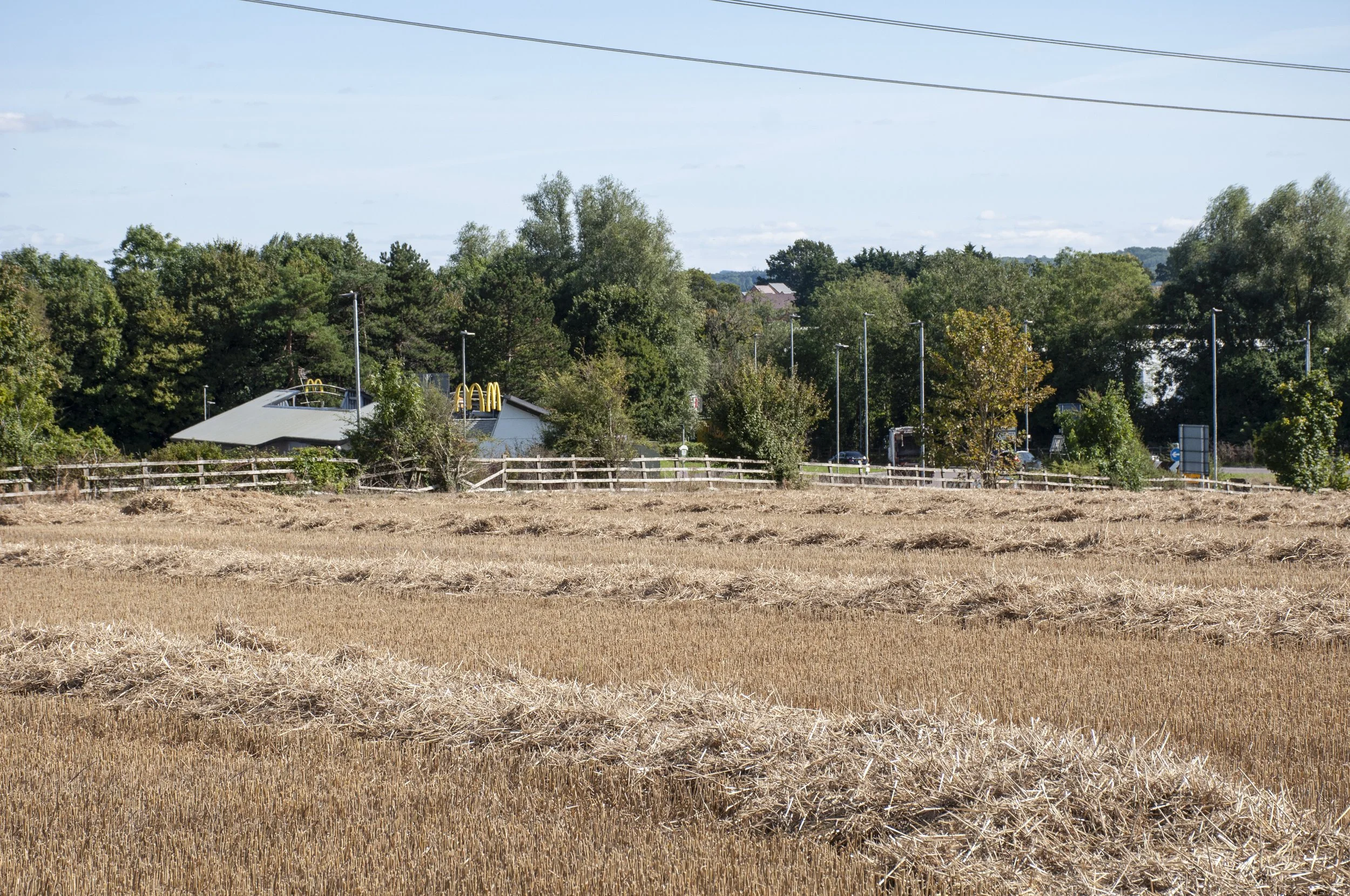
Field next to the A350, site of prehistoric and Roman finds
The path broke down amongst tussocks of grass and sapling trees, so I stepped into the next field via a gap in the hedge. This was the field that had been walked in the winter of 1987 by Wiltshire Rescue Archaeology Project and later by Thamesdown Archaeological Unit and archaeologists working with Chippenham College. It sloped down towards the A4; the A350 formed its eastern border, defined also by a line of pylons. A clump of trees occupied a small central spot. Telegraph poles carried cables east-west across the field. I could see the bendy, yellow capital M sign of McDonalds and south of the A4, beyond the roundabout, signage for Next, and the turn-off leading to the new KFC and Costa drive-through. I walked a short way between the crops. A small rounded shape lay ahead of me, a shade darker than the soil. It turned and disappeared over the brow of the field, then two more: hares. I had disturbed their afternoon grazing. Another two sprang up and loped away.
There was no grid reference for the findspot of the broken flint scraper so I had calculated the centre of the site instead, and now used GPS to find the position. I placed the photograph between two furrows, and lay on the stony ground to photograph the photograph of the flint in the area in which the flint had been found and, much earlier, almost certainly, manufactured and used. I moved on and found the grid reference for the flint scatter and tacked the photograph on to the wooden fence which separated the field from the A350; cow parsley, pulled along by the back-draught of the lorries, swayed amongst the grasses on the roadside bank. I took some photographs but the light was changing so I returned, via the proper gate this time, crossed the A4 and caught the bus home.
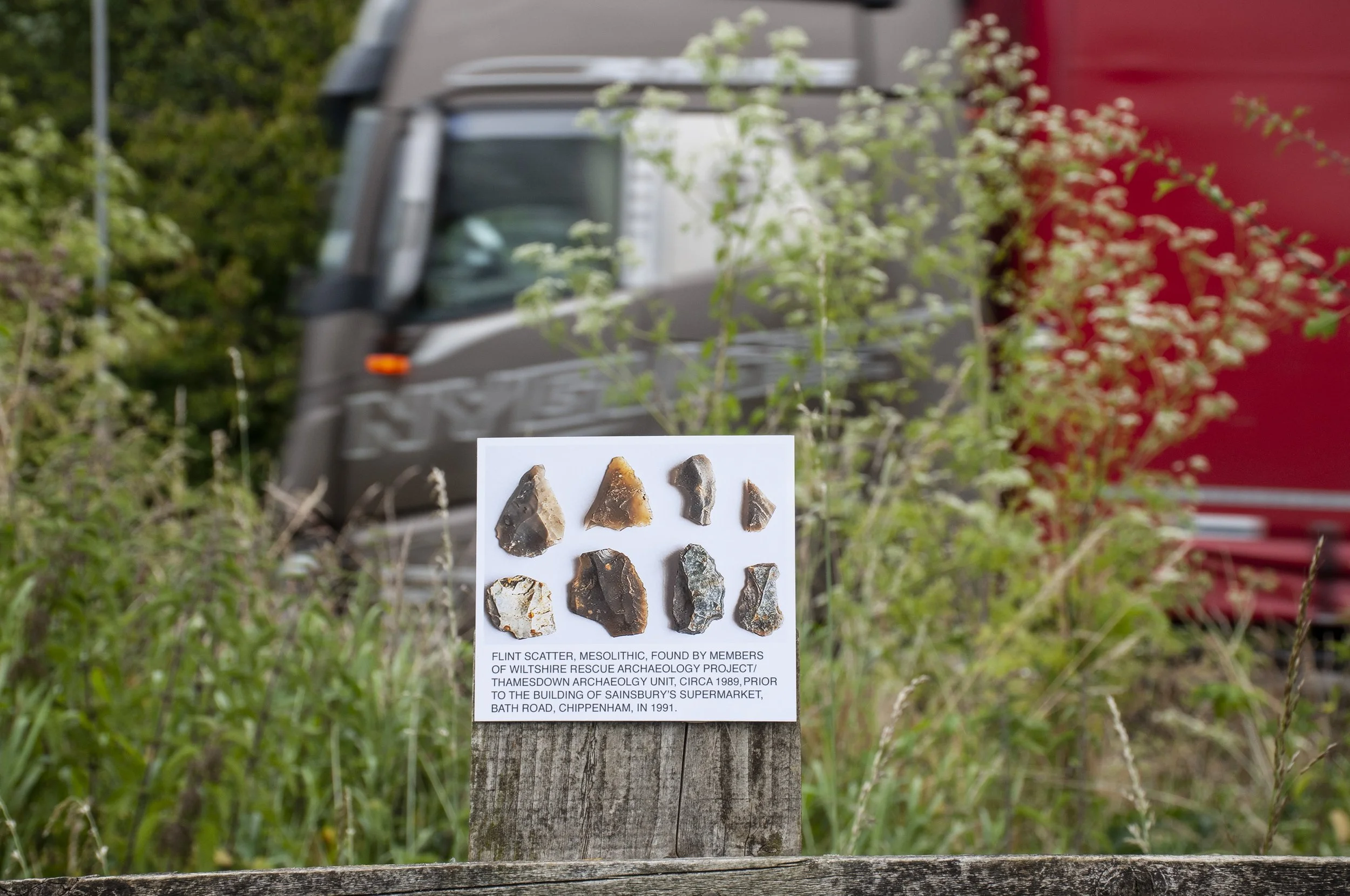
Flint Scatter, Mesolithic. Findspot: Sainsbury’s Supermarket Site, Bath Road, Chippenham
28th June Return Visit
I set out in the morning to revisit the field where the flints had been found. I wanted to take more photographs. The air was cool, there were grey clouds. This time the bus driver drove right into the lay-by; I got off and followed the route along the verge, grasses and other plants taller than last time, leaning over on to the path. The brambles and nettles at the gate were still pushed back from before. Once I was in the field, the hedge baffled the noise of the road. The track wove through thistles, numerous and sharp, then across the same grassy area with small reed-like plants, typical of damp ground. I found the gap in the hedge and stepped through. My previous visit had been in the afternoon, now the air felt fresh, despite the cloudy sky. This time I tacked the photograph of the broken flint scraper on to a wooden telegraph pole, with the findspot visible behind it. The wooden pole had cracks running up it, metal tags about six feet up, with numbers impressed, and a cable duct, attached to the side. Half hidden by the duct, some letters or numbers had been carved into the wood, a text known only to the engineers. I took photographs from different positions, moving the photograph up and down.
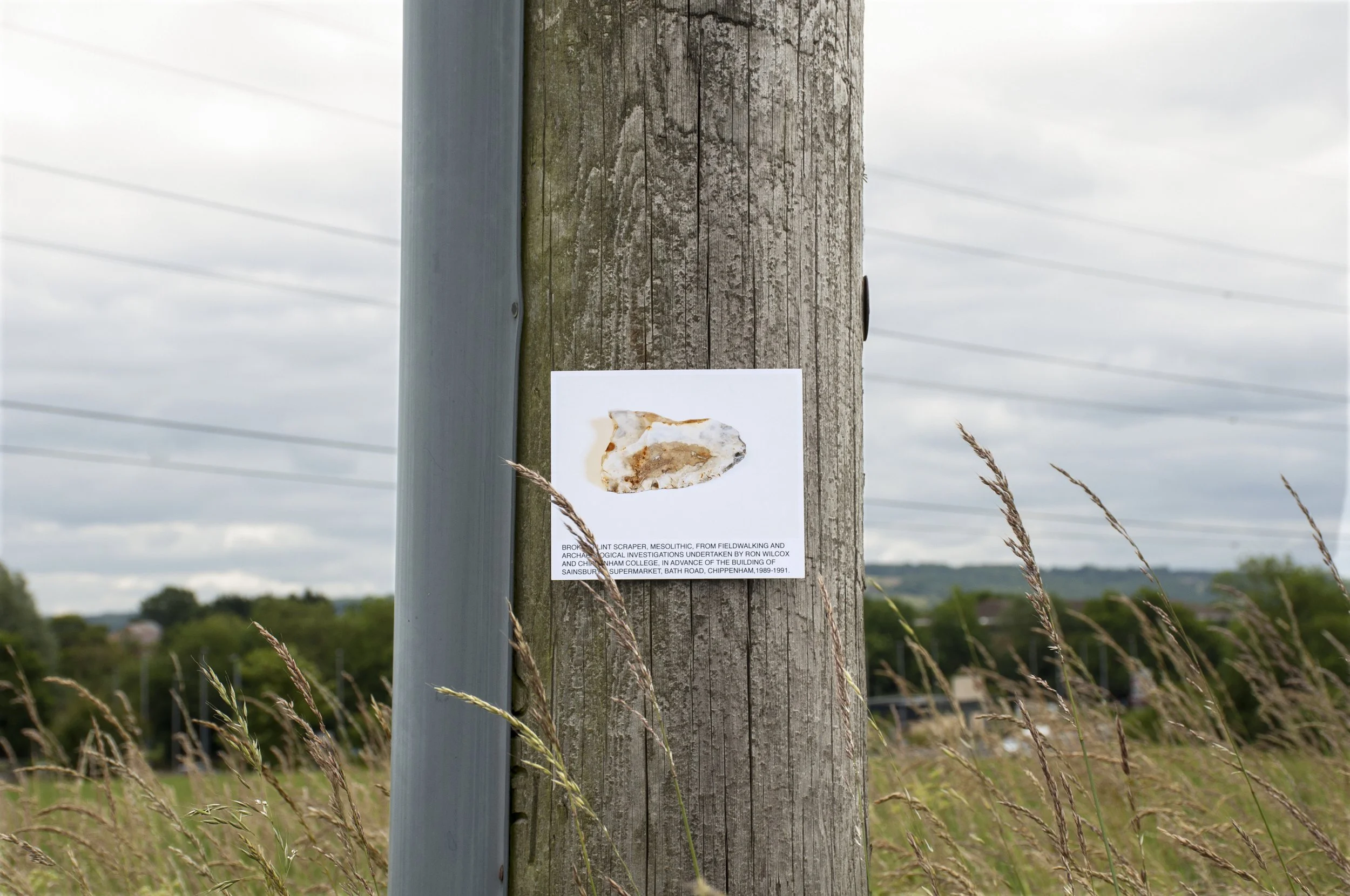
Broken Flint Scraper, Mesolithic. Findspot: Sainsbury’s Site, Bath Road, Chippenham
I returned to the findspot of the flint scatter. The only place to position the photograph was on the fence; I tacked it on and photographed it with the continuous flow of traffic in attendance: lorries – Welsh Mountain Zoo, Massey Wilcox, Tarmac, DHL – cars, trucks, vans, motorbikes, all passed by. The bikes whined up the incline. Articulated lorries, audible from afar, as they prepared for the ascent, displaced the air with their bulky load as they passed, thick tarpaulin covers billowing and taut, sides rattling, all filling the background. The continuous agitated hum of the traffic was a distraction, along with the accompaniment of the electricity pylons ticking and vibrating in the air above me. There was no silence, no sign of cessation. People were always going to be in motion here, driving, travelling, transporting.
After a drink and a sandwich I packed my bags and walked back up the field, taking my time, observing the ground, looking at the regular shapes of fossils, mainly bivalves, small round ones, neat and well defined, and larger elongated ones, their shapes often blunted and worn, and a fan-shaped one with ridges and striations in perfect regularity on both sides. Millions of years ago the field had been a seabed. I checked the bus times; I had just missed a bus and decided to wait for the next one rather than walking home, so I made my way back down to the A4, crossed over, and waited at the bus stop. When the bus arrived the driver asked where I had been. I visited again in September. The crop had been cut and there was just yellow stubble with casts of dry grass. A few days later, passing by, I noticed that the field had been ploughed, the yellow turned to brown, the hares no longer grazing.
26th March 2025
I returned to the field in the spring of the following year with a photograph of a fragment of Roman Samian ware, one of several sherds which had been found in the field. This particular piece had a letter M stamped on it, with an L next to it, possibly the makers mark or a record of the date. I approached from the bus stop in the lay-by, entering the field and following the lower hedge next to the road. The crop was coming up in straight lines of green shoots, but there was a wide strip at the bottom of the field which appeared to have been waterlogged and nothing was growing there. The soft ground was marked with the footprints of deer and pad-footed creatures; they too had kept to the perimeter of the field.
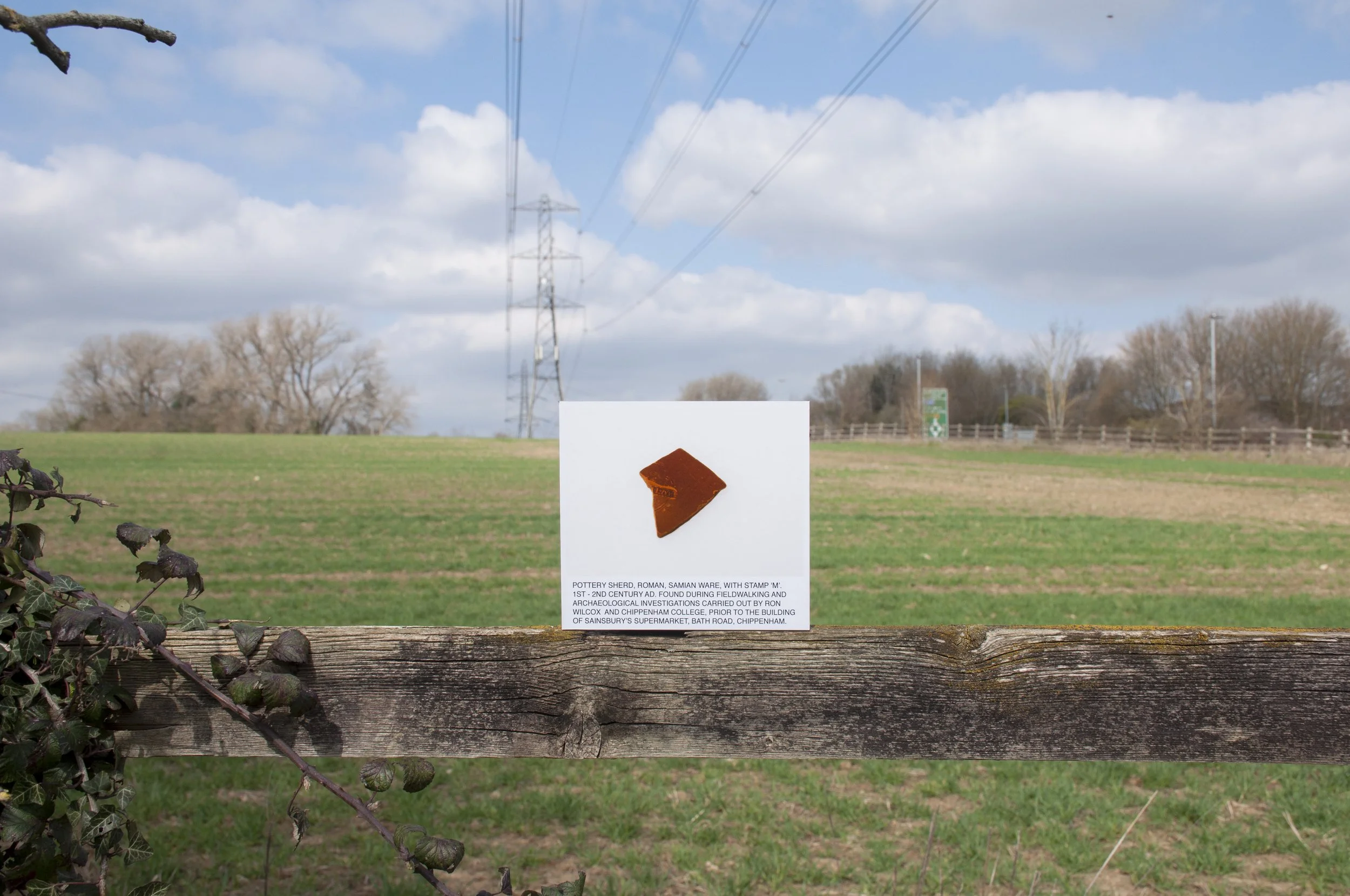
Pottery Sherd, Roman, Samian ware. Findspot: Sainsbury’s site, Bath Road, Chippenham
I reached the corner, where a significant number of Roman finds had been discovered; as I had no grid reference for the sherds, apart from a general one, this was the best place to position the photograph, within the area where the sherds had been found and the vessel or tile possibly made or used, and eventually discarded. A hare dug around in the furrows while I was setting up the photograph. It paused to look around, back legs bent, short front ones stretched; it stayed for some time, not bothered by my human presence, eventually, when I looked it was no longer there. I took some pictures with the photograph attached to the fence which enclosed the field. By mid-morning the sun was shining directly onto the image, illuminating the small L and M, framed by a rectangular border within a circle. The burnt orange of the Samian ware, even in the photograph, shone brightly, offset by the green field and blue sky. Clouds passed over, changing the light. I waited; when the shade filtered back across the field, I positioned the photograph on a patch of bare earth and took some more pictures. Last years stubble, short, light brown stems, broken, lay on the clay soil, green blades of the new crop pushing up all around. I took some photographs, then packed my bags and walked back to the bus stop in the lay-by.
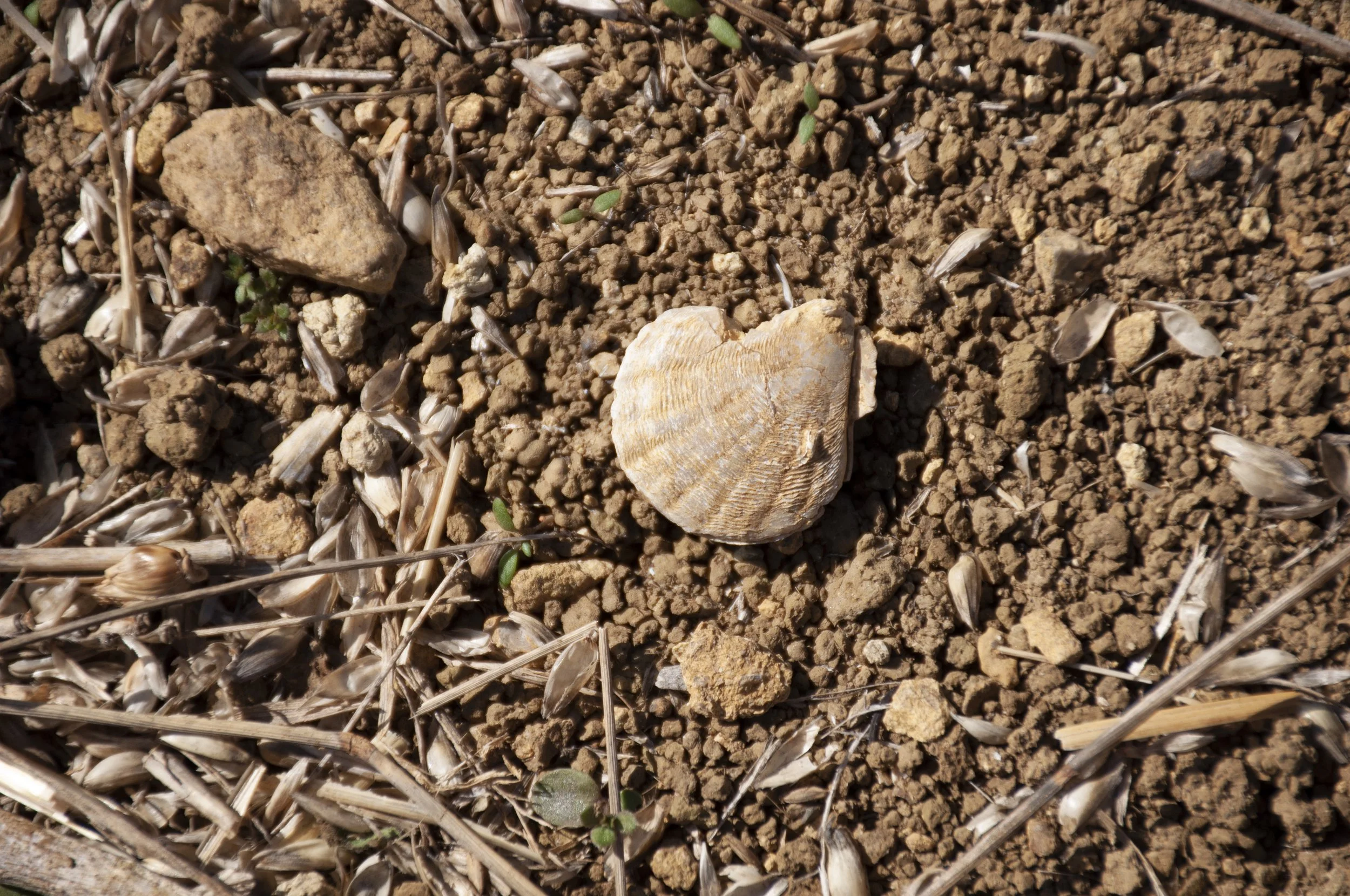
Fossil, collected in the field where the finds were discovered
Further Information about the Finds
The Flint Scraper
From the collection of Chippenham Museum, where it was photographed. The photograph was taken to the site and positioned in front of the findspot, where it was discovered in 1989 by Chippenham College Archaeology Department prior to the building of the Sainsbury’s supermarket. The flint scraper was one of the earliest finds to be made, from fieldwalking before the developer funded excavation. It may have been dropped, or lost, during the Mesolithic period and is part of the “slight but regular distribution of flintwork across the area”, referred to in the Wiltshire Rescue Archaeology Project report of 1987-88
Acknowledgements
Thanks to Alan Fuller, Exhibitions and Collections Officer, Chippenham Museum
Photograph published online with the kind permission of Chippenham Museum
References
Chippenham Museum Collection Database
Wiltshire Rescue Archaeology Project 1987-1988
Wiltshire Archaeological and Natural History Magazine Vol 84, 1989
The Flint Scatter
Photograph courtesy of Wiltshire Museum where the flint scatter is deposited. The photograph was taken to the spot where the flint scatter was found during fieldwalking in 1989. It is likely that these flints were dropped or discarded. Wiltshire Museum suggests that they are mainly waste from the production of flint tools
Acknowledgements
Photograph of the flint scatter published online with the kind permission of Wiltshire Museum
References
Devizes Museum Accession Register 1989.263
Wiltshire Rescue Archaeology Project 1989-1990
Wiltshire Archaeological and Natural History Magazine Vol 84, 1989, 143
Heritage Gateway Number: MWI2221
The Pottery Sherd
The sherd is part of a small group in the Chippenham Museum collection. The photograph was taken to the site and positioned directly in front of the findspot of 1989. The sherds reflect the substantial amount of Roman finds in this particular area, suggesting a settlement site nearby. The Wiltshire Rescue Archaeology Project report of 1987-88 refers to a” concentration of Roman material in the lower corner of the field” to the west of the A350, they also walked the site in the autumn of 1989: the investigations revealed a number of features, including a Romano-British boundary ditch and enclosure. The enclosure ditch contained substantial quantities of “Romano-British pottery, animal bones and teeth”, and appeared to have been in use from 1st to 4th centuries AD