South of Chiverlins Farm
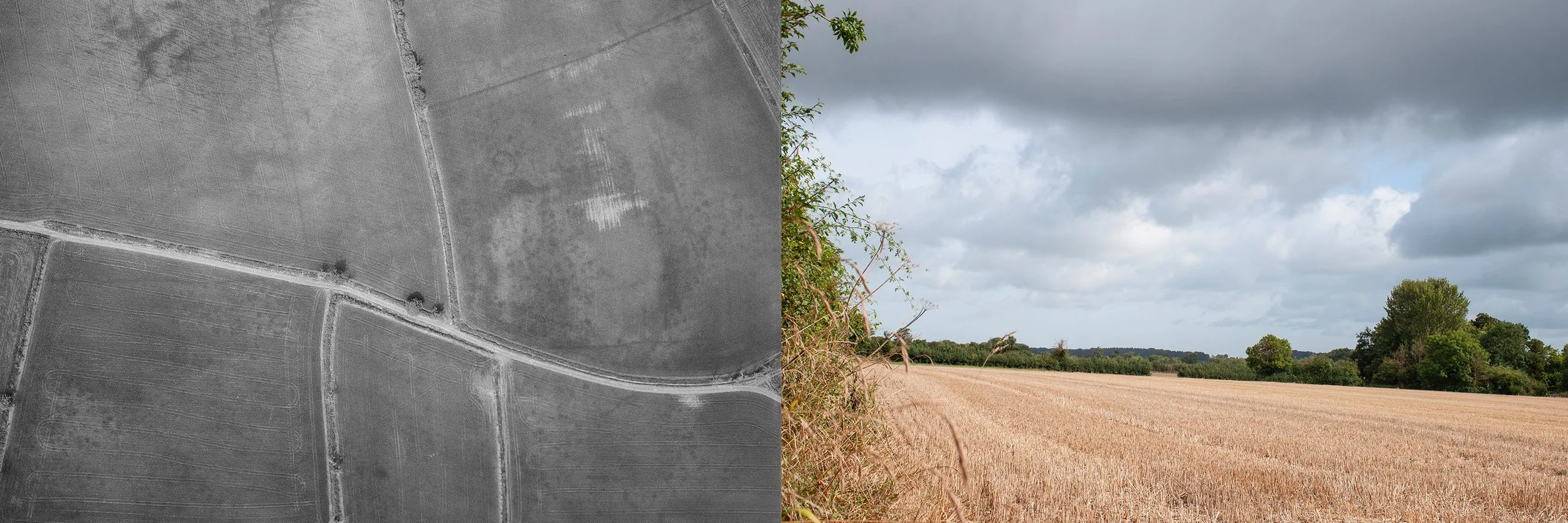
Aerial photograph, taken 2nd June 1982, for the National Monuments Record, showing a circular crop mark denoting a Bronze Age round barrow. Second photograph, the site of the round barrow, taken 29th August 2024, from the lower corner of the field
The crop mark representing a Bronze Age round barrow, in the field below a farm to the west of Chippenham, was photographed for the National Monuments Record in June 1982. There were several photographs taken that day and when I visited Historic England’s office in Swindon to search the archive, I chose the one which had the clearest representation: a small sooty circle on a grey background.
As there was no access to the field I decided to photograph the site as best I could from the footpath which ran below the southern border. I had visited the previous year and was returning this summer with a printed copy of the aerial photograph. The footpath ran in a straight line before curving to accommodate the shape of the field where the Bronze Age round barrow had been situated. My last visit had been in winter, and the hedge had been leafless, the field in clear view through the bare branches. Now, the hedge was in full leaf, a dense screen around the field, I walked back and forth along its course; there was not a suitable gap through which to photograph the site of the round barrow. At the corner however, the regular journeys of some animal had created a tunnel through the hedge, from the footpath into the field. I lay down and pointed my camera into the narrow passage and attempted to take a photograph without entering the field. The crop had been cut but the field had not been ploughed and there was stubble, bright in the morning light. Tall grasses and umbellifers leaned over from the hedge. Mainly, the landscape was unchanged; in the distance there was a gap which corresponded to a similar gap in the photograph and fortunately, I was able to frame the site of the Bronze Age round barrow.
During the summer and autumn I walked along the footpath several times. There was frequently a buzzard, hopping, wings hunched, in the long grass, or a kite circling in the sky above. When I was looking for a stone, a memento of the site, it was easy to pick one up from the edge of the field but in all the length of the footpath adjacent to the field there were no objects. Nothing dropped by dog walkers. A pile of litter had been deposited by the entrance to the footpath; empty cartons, papers, bottles, as if someone had deposited the contents of the footwell of their car, but this was too far from the site to qualify.
The journey back often involved a walk home; by the time I reached the lower lane, it was easier to continue down the hill to Stowell crossroads, then along to the A4. The road was quiet, with traffic only increasing towards the end of the working day when it was frequented by drivers taking a short cut home. It was almost the end of summer. The air was cooler. No more flowers would bloom. All the young birds had left their nests and sang from the tops of long stems, high in the hedges, or flew in flocks across the fields. I walked down the lane, weary after an afternoon spent trying to photograph something that was not there. I tried to identify the birdsong. There was one particular jangly exchange that sounded unfamiliar; there was an urgency to it. Some kind of call and response was taking place behind the hedge to my left; in fact there was a combative note amongst the two calls – one responding quickly before the other had finished, not a fight, but the quick high chirrup of discontent and a sharp rejoinder let loose on the still air. Curious as to what kind of battle could be taking place, seemingly from the furrows of the field, I approached the open gate. The noise stopped. There was a man, small, dapper, well groomed. His hair was oiled back, greying. He wore a sharply cut navy blazer over a blue and white striped t-shirt. He might have been modelling the clothes. They were not field clothes. His trousers, too, were smart, formal. He had brown eyes. We viewed each other. In his hands, which he held at waist level, were two, bright, but matt, viridian green spheres. We nodded and said hello. I carried on. Had the sound come from the green spheres? Were they musical ? They seemed to account for the presence of the man, alone in the field. Later, I wondered if I had brushed up against some act of enchantment, cast by the green spheres, as they transmitted their jingle down the lane and out across the fields.
Up the airy mountain
Down the rushy glen
We daren’t not go a-hunting
For fear of little men
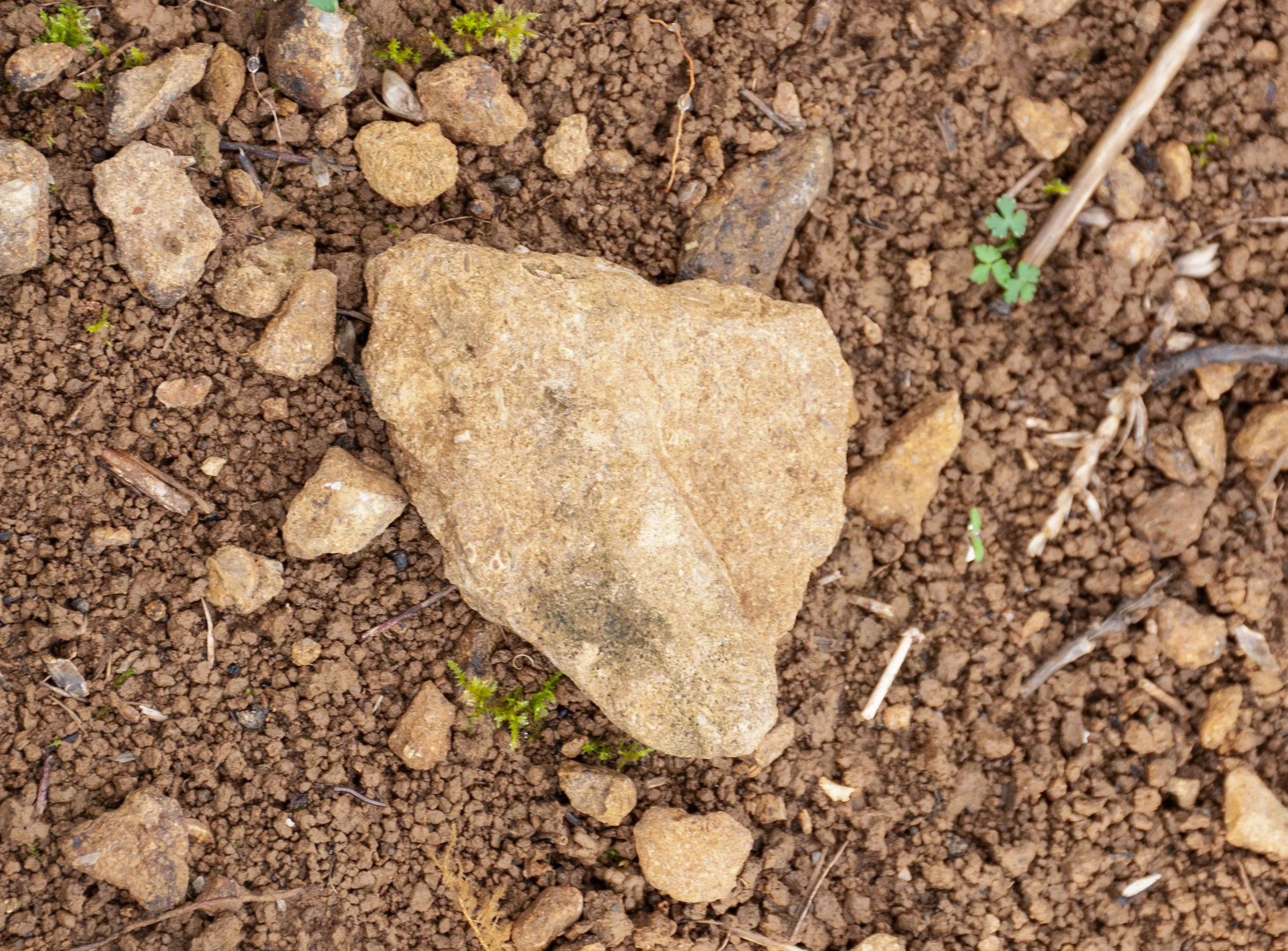
Stone from the field where the Bronze Age round barrow was situated