Derriads Farm
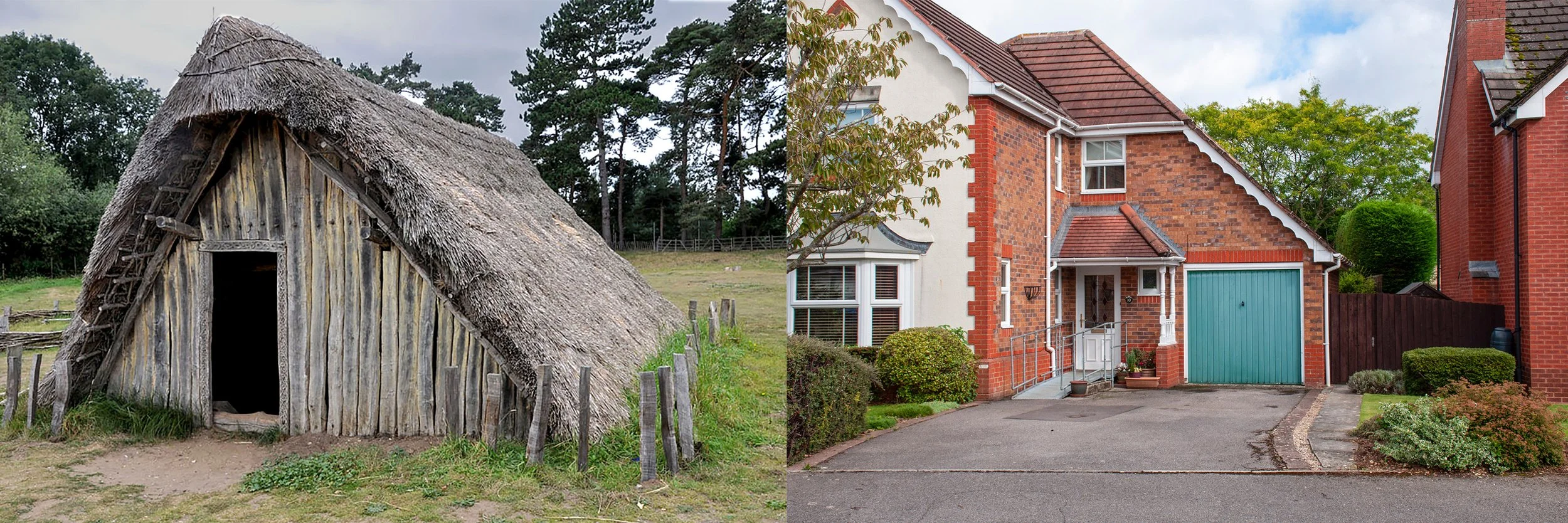
First photograph: reconstruction of Anglo-Saxon grubenhaus at West Stow Anglo-Saxon village. Second photograph, site of the grubenhaus, taken 11th September 2024
I had visited Brighton Way the previous year to identify the site of the Saxon grubenhaus. It had been discovered in 1989 by Wiltshire Rescue Archaeology Project, as revealed in a report which came to light during the Sites project. The term grubenhaus comes from the German: grube: pit, and haus: house, meaning sunken-floored building. It was used to describe roughly rectangular shaped buildings, where the earth inside, below the four walls, had been dug away, increasing the height of the building. There was nothing inside this particular one to indicate a date or function, but a post hole near the centre strongly suggested that it was a grubenhaus.
Brighton Way, up on the hill, basked in the late summer warmth. I walked along the short turn of the road. Trees, planted thirty years ago, when the estate was built, had reached maturity. Most of the houses on this part of the estate were built of red brick, and were similar, but with slightly different vernacular features. They all had an Edwardian look to them, with a front plot large enough to hold a small drive and a garage. Hedges and bushes had recently been clipped and the close-knit leaves of lonicera and large-leaved laurel formed private enclosures. Some of the gardens, having just a low brick wall, were on view, each one well maintained and fastidiously cultivated. Flower beds were edged with stone or slate; stone chippings were used as a surface material. One garden displayed two narrow ovals of grass, framed by dark purple slates, sited in a bed of gravel. Paths leading to the houses were defined by slate or bricks. Shrubs and perennial plants were at their best and seemed to have been chosen because they suited the warm, elevated conditions. Purple-flowered perovskia thrived in the dry heat, fuschia grew from amongst the stone chippings. Cordyline cast a spiked midday shadow across its bed of slate and a strap-leaved tuberous plant, seeds forming in sappy green pods, was surviving in one of the little beds.
I had identified a house which stood just to the left of the site of the grubenhaus and wandered up to the top of the close, and then down, rather than approach directly. Unusually, this house had a cream coloured stucco front. Wisteria climbed up to the roof and buddleia grew in the garden. A lonicera hedge, trimmed into a bolster shape, defined half of the front plot. I positioned myself in front of the house and took some photographs, concentrating on the trees growing in the back garden, where the grubenhaus had been discovered. It was nearly midday and the sky was deep blue, white weatherboards shone in the sunlight. There were no vehicles parked on the road and no signs of life. The cultivated gardens were the only evidence of human activity and occupation. I finished taking photographs and walked back down to the A4, following the long sweep of Sandown Drive.
I returned at the end of summer to look for a stone and an object, contemporary finds from the site. Brighton Way, like most of the roads in Cepen Park, is without litter or debris; there was a lot of imported stone, some spilling out of the infill of the drive ways, and eventually I picked up a small piece of flint from opposite the site of the grubenhaus. Then, having walked up one side of the road and down the other, I noticed two small fragments of glass, gleaming brightly, followed by a small nut with a decoration around its edge and finally, just before I returned to Sandown Drive, I picked up a white plastic loop, like the ring pull on a tin can.
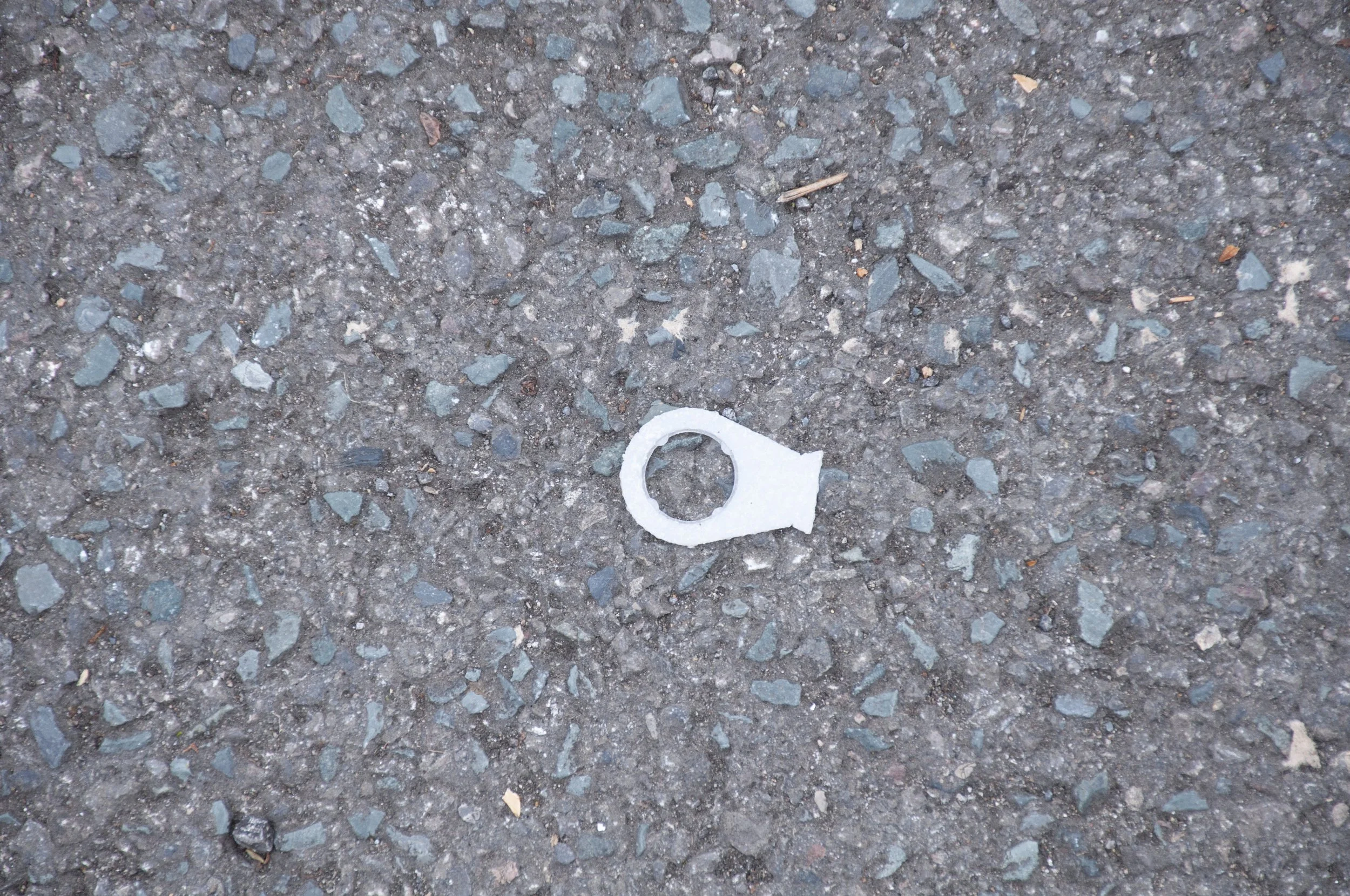
Plastic ring-pull found on the crescent where the grubenhaus had been situated